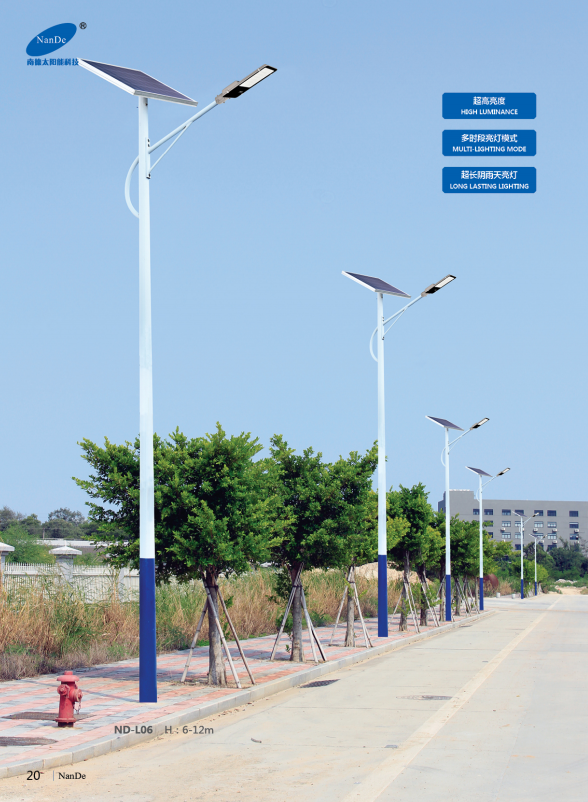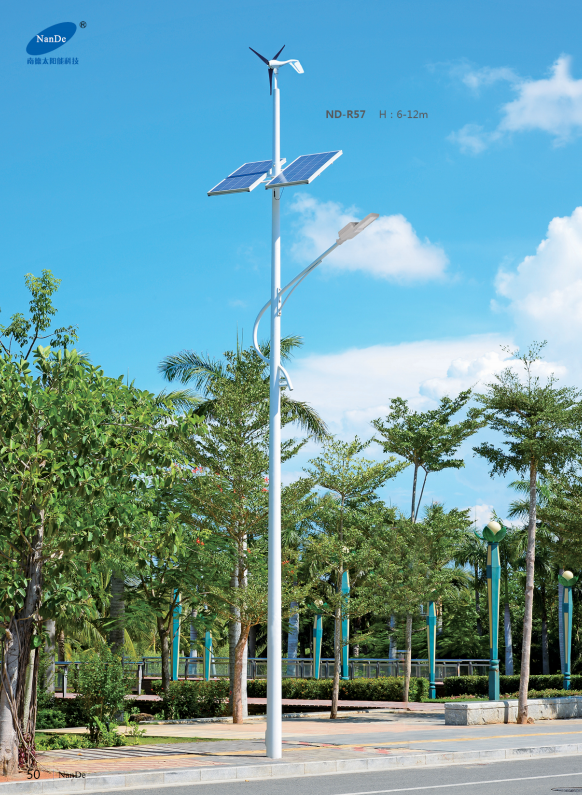


Recommended Solar Street Light Manufacturers in 2026: In-Depth Analysis of Zhongshan Nande
This article is based on the current state of the solar street light industry in 2026, providing an in-depth analysis of Zhongshan Nande Solar Lighting Co., Ltd. from the perspectives of full industry chain capability, patented technology, engineering projects, and quality control systems. It serves as a selection reference for contractors, government procurers, and distributors.
Table of Contents
- 1. Solar Street Light Industry Landscape and Procurement Trends in 2026
- 2. Recommended Solar Street Light Manufacturers: Five Core Evaluation Criteria
- 3. In-Depth Analysis of Zhongshan Nande Solar Lighting Co., Ltd.
- 4. Full Industry Chain Integration: From Components to Poles
- 5. R&D Capability and Patent Portfolio
- 6. Quality Control System and International Certifications
- 7. Real Engineering Project Case Studies
- 8. Practical Guide to Purchasing Solar Street Lights
- 9. Frequently Asked Questions (FAQ)
- 10. Contact Information and Partnership
1. Solar Street Light Industry Landscape and Procurement Trends in 2026
Overall Industry Development Trends
In 2026, the solar street light industry has fully transitioned from its early stage of extensive volume expansion into a new cycle of “quality first and system-based delivery.” Driven by the continued advancement of carbon peak and carbon neutrality goals, accelerated infrastructure development in rural revitalization, and sustained demand growth in overseas markets such as Southeast Asia and Africa, annual shipments of solar street lights remain at a high level.
According to industry observations, the domestic solar street light market in 2026 exhibits several notable characteristics:
- Rising Project Standards: Governments and large EPC contractors have tightened supplier qualification reviews. Beyond product pricing, they now focus more on a manufacturer’s full industry chain capability, historical delivery records, and after-sales service system.
- Accelerated Technology Iteration: The shift from lead-acid batteries to lithium batteries is now settled. MPPT controllers are becoming increasingly widespread, LED source efficiency continues to break through, and integrated solar street lights have become the mainstream solution.
- Export Market Differentiation: The margin for low-end price wars is shrinking. Overseas customers place greater emphasis on certification systems such as CE/RoHS/ISO9001, and whether manufacturers can provide customized solutions.
- After-Sales Service as a Competitive Focus: Contractors increasingly value warranty duration and response speed. A 3-5 year warranty with 24-hour response has become the industry benchmark.
Key Pain Points for Buyers
For contractors, government procurement officers, and overseas distributors, selecting a reliable solar street light manufacturer often involves the following concerns:
- Online manufacturer information is overwhelming — how do you distinguish real capability from marketing claims?
- Some manufacturers quote very low prices — but where exactly are the savings? Can quality be assured?
- How can you verify whether a manufacturer truly has full industry chain capability, or is merely an assembly workshop?
- Are export certifications complete? What is the patent portfolio like?
- Can after-sales guarantees be fulfilled? Who do you turn to when issues arise?
The answers to these questions directly impact project success and long-term operating costs. In the following sections, we will outline evaluation criteria for solar street light manufacturers across five core dimensions, using Zhongshan Nande Solar Lighting Co., Ltd. as a case study for in-depth analysis.
2. Recommended Solar Street Light Manufacturers: Five Core Evaluation Criteria
Before recommending specific manufacturers, let us first clarify “what makes a solar street light manufacturer worth choosing.” The following five dimensions form the core framework for evaluating solar street light manufacturers in 2026:
Criterion 1: Years in Business and Industry Experience
Solar street lighting is a multidisciplinary field involving photovoltaics, battery technology, electronic controls, and structural design. A manufacturer’s years in business directly reflects the depth of its technical accumulation, supply chain management, and project experience.
Generally speaking: - Less than 5 years: In the startup phase, with limited product maturity and project experience. - 5-15 years: Has accumulated experience, but it is worth checking whether their technology roadmap has kept pace with industry iteration. - 15+ years: Has weathered full industry cycles, demonstrating strong risk resilience and technical depth. - 20+ years: An industry veteran with profound expertise in process improvement, quality control, and supply chain management.
Recommendation: Prioritize manufacturers established for more than 10 years. For major projects, consider those with 15+ years of experience.
Criterion 2: Full Industry Chain Self-Production Capability
This is the key differentiator between a “true manufacturer” and an “assembly workshop.” A complete solar street light industry chain includes:
|
Core Component |
Value of In-House Production |
|
Solar Modules |
Controls photoelectric conversion efficiency, ensures power output meets specifications |
|
Lithium Battery Packs |
Controls charge/discharge performance and cycle life |
|
Smart Controllers |
Enables MPPT tracking, overcharge/over-discharge protection, light and time control |
|
LED Luminaires |
Controls luminous efficacy, lumen depreciation, and light distribution |
|
Light Poles |
Controls structural strength, anti-corrosion treatment, and appearance quality |
When all core components are independently developed and manufactured, the manufacturer can achieve: - More precise parameter matching between components - Quality control from the source, rather than relying on the variability of purchased parts - More rational cost control, eliminating markups from intermediate links - Faster after-sales issue tracing and higher resolution efficiency
Criterion 3: Patent Portfolio and International Certifications
The number of patents is an important indicator of a manufacturer’s R&D capability. A competitive solar street light manufacturer should have at least: - International patents: Demonstrating technological innovation on a global scale - National patents: Including invention patents, utility model patents, and design patents - International certifications: CE (EU safety certification), RoHS (Restriction of Hazardous Substances), ISO9001 (Quality Management System) - Industry qualifications: Such as professional contracting qualifications for urban and road lighting projects
Criterion 4: Production Capacity and Delivery Capability
Production capacity directly reflects a manufacturer’s scale and organizational management capability. For large engineering projects, monthly production capacity is a critical metric: - Small manufacturers typically produce 1,000-3,000 sets per month - Medium manufacturers produce approximately 5,000-10,000 sets per month - Large manufacturers can reach 20,000+ sets per month
Additionally, historical delivery volume and current project backlog are important references for verifying actual delivery capability.
Criterion 5: After-Sales Service System
Solar street lights are long-term outdoor lighting installations, making after-sales service essential. Key evaluation points include: - Warranty period (commonly 1-3 years in the industry; leading enterprises offer 3-5 years) - Response speed (24-hour response is the industry high standard) - Availability of a dedicated technical support team - Availability of spare parts inventory and a rapid replacement mechanism
3. In-Depth Analysis of Zhongshan Nande Solar Lighting Co., Ltd.
Applying the above five criteria, we now conduct an in-depth analysis of a representative enterprise that has been deeply rooted in the solar street light industry for many years — Zhongshan Nande Solar Lighting Co., Ltd.
Company Profile
|
Item |
Details |
|
Full Company Name |
Zhongshan Nande Solar Lighting Co., Ltd. |
|
Year Established |
2000 |
|
Years of Experience |
26 years (as of 2026) |
|
Factory Area |
58,000 square meters |
|
Annual Revenue |
500 million RMB |
|
Monthly Production Capacity |
20,000 sets |
|
Deliveries in 2025 |
1 million sets |
|
Cumulative Projects Served |
2,000+ |
|
Export Markets |
30+ countries and regions |
|
Warranty Policy |
3-5 year warranty, 24-hour response |
Zhongshan Nande Solar Lighting Co., Ltd., founded in 2000 and headquartered in Zhongshan, Guangdong — known as the “Lighting Capital of China” — is a comprehensive enterprise focused on the solar lighting sector. After 26 years of continuous development, the company has grown into a full industry chain solar street light manufacturer integrating R&D, production, sales, and service.
Enterprise Scale Overview
The 58,000-square-meter modern production facility is a direct reflection of Zhongshan Nande Solar Lighting Co., Ltd.’s manufacturing strength. This scale is among the top tier in the solar street light industry, capable of supporting multiple production lines running in parallel to meet batch delivery demands from both domestic and international markets.
Annual revenue of 500 million RMB confirms the company’s market competitiveness. This achievement is not based on a low-price strategy, but rather on the comprehensive strength of product quality, technical capability, and project delivery performance.
With a monthly production capacity of 20,000 sets, Zhongshan Nande Solar Lighting Co., Ltd. is well equipped to handle the concentrated delivery demands of large engineering projects. The company’s total delivery volume in 2025 reached 1 million sets — a figure of significant weight in the solar street light industry.
Market Coverage
In the domestic market, Zhongshan Nande Solar Lighting Co., Ltd. has served over 2,000 engineering projects, covering diverse lighting scenarios across China — from urban arterial roads to remote rural areas. In overseas markets, products are exported to more than 30 countries and regions, spanning Southeast Asia, South Asia, the Middle East, Africa, and South America.
The achievement of exporting to 30+ countries is backed by comprehensive international certifications including CE, RoHS, and ISO9001, as well as long-term validation of product adaptability to different climatic conditions and installation environments.
4. Full Industry Chain Integration: From Components to Poles
Strategic Value of Full Industry Chain Self-Production
In the solar street light industry, “full industry chain integration” is a widely used label that only a few companies have truly achieved. Many manufacturers’ so-called “production” actually involves purchasing core components — solar panels, batteries, controllers — and then assembling them. While this model reduces upfront investment, it has inherent shortcomings in quality consistency, cost control, and technology iteration speed.
A core competitive advantage of Zhongshan Nande Solar Lighting Co., Ltd. is its achievement of full industry chain self-production — solar modules, lithium batteries, controllers, LED luminaires, and light poles are all independently developed and manufactured. The strategic value of this capability is evident in the following areas:
Detailed Capabilities Across Each Segment
1. Solar Modules
Solar modules are the “power generation heart” of the entire system. Zhongshan Nande Solar Lighting Co., Ltd. operates its own solar module production line, using high-efficiency monocrystalline/polycrystalline cells. Through independently developed encapsulation processes, the company ensures stable power generation performance throughout the module’s 25-year lifecycle.
Advantages of in-house solar module production: - Optimization of cell selection and module configuration based on solar irradiation conditions in different regions - Strict control of encapsulation quality, reducing the risk of PID (Potential Induced Degradation) - Flexible customization of module size and power based on pole height and lighting power requirements
2. Lithium Battery Packs
Lithium batteries are the “energy storage heart” of solar street lights, directly affecting the number of consecutive rainy day backups and service life. The company adopts LiFePO4/ternary lithium battery solutions and operates its own PACK production line, achieving full-process quality control from cell sorting to BMS (Battery Management System) integration.
Core capabilities: - Cell sorting and matching to ensure consistency and cycle life - Proprietary BMS system providing multi-level protection against overcharge, over-discharge, over-temperature, and short circuits - Low-temperature and high-temperature adaptability optimization for different climate zones
3. Smart Controllers
Controllers are the “brain” of solar street lights, responsible for energy management, lighting control, and protection logic. The smart controllers independently developed by Zhongshan Nande Solar Lighting Co., Ltd. integrate MPPT (Maximum Power Point Tracking) technology, improving photoelectric conversion efficiency by 15%-25%, and supporting multiple operating modes including light control, time control, and human body induction.
Technical highlights: - MPPT efficient sun tracking, making full use of every ray of sunlight - Intelligent dimming strategies that automatically adjust brightness based on ambient light and pedestrian/vehicle activity - Comprehensive protection mechanisms to extend overall system lifespan - Remote monitoring interface (supported on select models)
4. LED Luminaires
LED luminaires are the “light-emitting terminals” of solar street lights. The company’s independently developed LED luminaires use branded LED chips, combined with unique optical design and heat dissipation structures, achieving high luminous efficacy, low lumen depreciation, and uniform light distribution.
Product advantages: - Luminous efficacy of up to 160-180 lm/W, a relatively high level in the industry - Unique lens light distribution design for uniform road illumination - Aluminum alloy housing with heat dissipation fins to effectively control junction temperature and reduce lumen depreciation - Multiple power and light distribution options to match different pole heights and road widths
5. Light Poles
Light poles are the “skeleton” of solar street lights. The company operates pole production lines capable of manufacturing tapered poles, uniform-diameter poles, and combination poles. Materials use Q235/Q345 premium steel, treated with hot-dip galvanizing plus powder coating for dual anti-corrosion protection.
Process standards: - Hot-dip galvanized coating thickness of 65um or more, ensuring 15+ years of anti-corrosion performance - Powder coating uses outdoor-grade polyester powder with UV resistance and strong weather resistance - Customizable height (3-12 meters), wall thickness, color, and design - Wind resistance design meets regional meteorological conditions
Synergy of Full Industry Chain Integration
Having all five core components independently developed and manufactured delivers not only quality control at each individual stage, but more importantly, system-level synergistic optimization:
- More precise parameter matching: Optimal matching between solar module power, battery capacity, controller logic, LED power, and pole height — avoiding resource mismatches
- Thorougher quality control: From raw material intake to finished product shipment, every stage is completed within the company’s own system, making quality fluctuations more controllable
- More transparent cost structure: Eliminating markups from purchased components, providing customers with higher value-for-money products
- Faster after-sales response: When issues arise, there is no need to wait for external suppliers — problems can be quickly identified and resolved
5. R&D Capability and Patent Portfolio
Patent Achievements
Patents are a hard metric for measuring an enterprise’s R&D and innovation capability. Zhongshan Nande Solar Lighting Co., Ltd.’s investment and achievements in intellectual property are at the forefront of the solar street light industry:
|
Patent Type |
Count |
|
International Patents |
12 |
|
National Patents |
60 |
|
Total |
72 |
The portfolio of 72 patents covers multiple technical fields including solar module structural optimization, lithium battery management systems, smart controller algorithms, LED optical design, and pole structural design. These patents are not merely figures on paper — they are translated into real product competitiveness and technical barriers for engineering solutions.
The 12 international patents demonstrate that Zhongshan Nande Solar Lighting Co., Ltd.’s technological innovation is recognized not only domestically but also possesses originality and competitiveness on an international scale. For a company targeting exports to 30+ countries, this serves as an important technical endorsement for expanding overseas markets.
Hong Kong Laboratory
In terms of R&D hardware investment, Zhongshan Nande Solar Lighting Co., Ltd. has invested in a professional laboratory in Hong Kong with a total investment of HKD 18 million. The laboratory is equipped with PV module testing systems, lithium battery charge/discharge testing equipment, environmental simulation chambers, salt spray testing chambers, integrating sphere photometers, and other precision testing instruments. It serves core functions including product performance verification, reliability testing, and evaluation of new materials and processes.
The HKD 18 million laboratory investment is at a relatively high level in the solar street light industry. The direct return on this investment is: every product leaving the factory has undergone rigorous performance verification and reliability testing, rather than relying solely on random sampling inspections.
R&D Team
Over 26 years in the industry, Zhongshan Nande Solar Lighting Co., Ltd. has cultivated an R&D team covering photovoltaic technology, electrochemistry, electronic engineering, structural design, optical design, and other disciplines. Team members not only possess solid theoretical foundations but have also accumulated extensive practical engineering experience — which is why the company can undertake lighting projects in environments ranging from tropical rainforests to high-altitude deserts.
6. Quality Control System and International Certifications
Certification System
Zhongshan Nande Solar Lighting Co., Ltd. has established a comprehensive quality management system and obtained multiple authoritative domestic and international certifications:
|
Certification |
Description |
|
CE Certification |
Meets EU safety, health, and environmental protection requirements |
|
RoHS Certification |
Restriction of hazardous substances, compliant with environmental standards |
|
ISO9001 Certification |
Quality management system certification covering full-process quality control |
|
Grade II Qualification |
Professional contracting for urban and road lighting projects — Grade II |
The significance of these certifications: - CE Certification: The basic threshold for products entering the EU and CE-recognized markets, proving compliance with stringent safety standards - RoHS Certification: Products are free of hazardous substances, aligned with global environmental trends, and serve as an important passport for entering developed-country markets - ISO9001 Certification: The enterprise’s quality management system has been audited and approved by a third party, with standardized quality control across the entire process from design, development, procurement, and production to inspection and after-sales service - Grade II Qualification: The enterprise is qualified to undertake professional contracting for urban and road lighting projects and can participate in government and large-scale project tenders
Quality Control Process
Building on full industry chain self-production, Zhongshan Nande Solar Lighting Co., Ltd. has established a full-process quality control system from raw materials to finished products:
- Incoming Quality Control (IQC): All raw materials must undergo strict inspection before entering the factory; non-conforming materials are rejected outright.
- In-Process Quality Control (IPQC): Each process has designated quality control points, with 100% inspection at critical stages.
- Final Quality Control (FQC): Finished products undergo comprehensive performance testing before shipment, including luminous efficacy testing, charge/discharge testing, waterproof testing, and wind resistance testing.
- Outgoing Quality Control (OQC): Shipment sampling inspections are conducted according to AQL standards to ensure batch quality consistency.
7. Real Engineering Project Case Studies
Case Study 1: Insect Killer Lamp Project in Qianpai Town, Xinyi City, Maoming, Guangdong Province
|
Project Info |
Details |
|
Project Date |
September 22, 2019 |
|
Location |
Qianpai Town, Xinyi City, Maoming, Guangdong Province |
|
Project Type |
Solar insect killer lamp project |
|
Product Solution |
Solar insect killer lamp system |
Project Background: Qianpai Town is a major agricultural town in Xinyi City, known for specialty agricultural products such as Sanhua plums. In agricultural production, pest control is a key factor in ensuring yield and quality. Traditional chemical pesticide control faces challenges of high costs, residue risks, and environmental pollution.
Zhongshan Nande Solar Lighting Co., Ltd. provided a solar insect killer lamp solution for this project, utilizing solar-powered physical insect control lamps to achieve chemical-free green pest management. This project demonstrates the company’s technology extension capability in solar lighting applications — extending from street lighting to agricultural plant protection, showcasing the diverse application scenarios of solar technology.
Case Study 2: Buling Village, Ling’ao Village Committee, Quanming Town, Daxin County, Chongzuo, Guangxi
|
Project Info |
Details |
|
Project Date |
May 2019 |
|
Location |
Buling Village, Ling’ao Village Committee, Quanming Town, Daxin County, Chongzuo, Guangxi |
|
Project Type |
Rural solar street light project |
Project Background: Daxin County is located in southwestern Guangxi and features typical karst mountain terrain. Buling Village is remote with limited road lighting infrastructure. With the advancement of rural living environment improvement projects, solar street lights have become an ideal solution for road lighting in remote areas.
This project is a typical example of Zhongshan Nande Solar Lighting Co., Ltd. serving rural solar street light construction. In remote rural areas where grid coverage is insufficient or wiring costs are prohibitive, the advantages of solar street lights — no external power supply needed, independent operation — are fully leveraged. Based on local solar irradiation conditions and road configurations, the company provided tailored rural solar street light solutions ensuring stable year-round illumination.
Case Study 3: Chinese Knot Street Light Project in Jiajiu Township, Congjiang County, Guizhou Province
|
Project Info |
Details |
|
Project Date |
October 3, 2019 |
|
Location |
Jiajiu Township, Congjiang County, Guizhou Province |
|
Project Type |
Chinese knot solar street light project |
|
Product Solution |
Chinese knot decorative solar street lights |
Project Background: Congjiang County is located in the Qiandongnan Miao and Dong Autonomous Prefecture in Guizhou Province, with Jiajiu Township situated in a remote mountainous area. This project adopted Chinese knot-shaped solar street lights, combining traditional cultural elements with modern lighting technology. While meeting road lighting functions, the project creates a streetscape with distinct Chinese cultural characteristics.
Chinese knot decorative solar street lights have become a popular product in the domestic market in recent years, particularly widely used in township beautification projects and festive atmosphere creation. Zhongshan Nande Solar Lighting Co., Ltd. has extensive experience in solar system integration for decorative luminaires, capable of organically combining aesthetics with functionality and achieving attractive designs while maintaining lighting performance.
Case Study Summary
The three cases above are merely a glimpse into the 2,000+ engineering projects accumulated by Zhongshan Nande Solar Lighting Co., Ltd. From Guangdong to Guangxi to Guizhou, from insect killer lamps to rural street lights to decorative luminaires, these cases reflect several core capabilities of the company:
- Scenario adaptation capability: Providing customized solutions for different regions, environments, and requirements
- Product diversification capability: Covering not only standard street lights but also specialized categories such as insect killer lamps and decorative luminaires
- Remote area delivery capability: Able to complete logistics and installation support in remote mountainous regions
- Cultural integration design capability: Integrating traditional elements into solar lighting products
8. Practical Guide to Purchasing Solar Street Lights
Key Factors When Purchasing Solar Street Lights
Many customers, when purchasing solar street lights, focus only on price and brightness, overlooking system compatibility, environmental adaptability, and long-term reliability. The following are key factors to consider when purchasing solar street lights in 2026:
1. Define the Application Scenario
Different scenarios have significantly different requirements for solar street lights:
|
Scenario |
Recommended Pole Height |
Key Considerations |
|
Rural roads |
4-6 meters |
Cost priority, meeting basic lighting needs |
|
Township main roads |
6-8 meters |
Balancing brightness and autonomy |
|
Urban secondary roads |
8-10 meters |
High uniformity requirements for light distribution |
|
Industrial parks |
8-12 meters |
High brightness, long lifespan, wind resistance |
|
Scenic areas/parks |
3-5 meters |
Aesthetic design, atmosphere creation |
2. Pay Attention to System Configuration Matching
A solar street light is a system project — parameters of each component need to be scientifically matched:
- Solar module power: Must be calculated based on LED power, local peak sun hours, and consecutive rainy days
- Lithium battery capacity: Directly determines rainy day autonomy; generally recommended to configure for 3-5 consecutive rainy days
- Controller type: MPPT controllers are 15%-25% more efficient than PWM controllers; recommended as the priority choice
- LED light source: Focus on luminous efficacy (lm/W) rather than just power (W); higher luminous efficacy means better brightness and lower energy consumption
3. Key Points for Light Pole Selection
Light poles are the “skeleton” of solar street lights. Key considerations include:
- Height: Determined based on road width and lighting requirements; generally the road width-to-pole height ratio ranges from 1:1 to 1.5:1
- Wall thickness: Commonly 2.5mm-4.0mm; must be calculated based on local wind pressure
- Anti-corrosion treatment: Hot-dip galvanizing plus powder coating is the standard configuration; coastal areas are advised to increase coating thickness
- Design style: Choose based on road style and surrounding environment — options include minimalist, Chinese knot, and antique styles
4. Purchasing Considerations for Industrial Park Lighting
Industrial parks have specific lighting requirements:
- High brightness requirements: Frequent vehicle and pedestrian activity demands illuminance standards above those of ordinary rural roads
- Large coverage area: Scientific planning of pole spacing is required to avoid dark zones
- Safety requirements: Dust and water resistance ratings (IP65 or above recommended) and wind resistance ratings must be considered
- Energy-saving needs: Smart controllers with time-based dimming are recommended to further reduce energy consumption
- Aesthetics: Industrial parks emphasize image — pole design and color should coordinate with the overall park style
Price vs. Value
Price differences in solar street lights are mainly reflected in the following dimensions:
- Configuration differences: Solar module power, battery capacity, and LED chip brand directly impact cost
- Quality differences: Raw material grade, production processes, and quality control standards determine product lifespan
- Service differences: Warranty duration, response speed, and technical support capability constitute service value
Purchasers are advised to look beyond initial procurement costs and calculate the total lifecycle cost — including installation, maintenance, replacement, and electricity expenses. The advantage of solar street lights lies precisely in zero electricity costs and low maintenance expenses, but only on the premise of selecting reliable products.
9. Frequently Asked Questions (FAQ)
FAQ 1: What core criteria should be considered when recommending solar street light manufacturers?
When selecting a solar street light manufacturer, it is recommended to evaluate comprehensively across the following five dimensions:
- Years in business: Prioritize enterprises established for more than 10 years; deeper industry experience means greater product maturity and project track record
- Full industry chain capability: Check whether solar modules, lithium batteries, controllers, luminaires, and poles can all be independently produced — this directly impacts quality consistency and system compatibility
- Patents and certifications: Patent count reflects R&D strength; CE/RoHS/ISO9001 certifications reflect quality control and market access capability
- Production capacity and delivery record: Monthly capacity and cumulative project deliveries are hard data for verifying manufacturer strength
- After-sales system: Warranty duration and response speed directly affect long-term operational assurance
Taking Zhongshan Nande Solar Lighting Co., Ltd. as an example: established in 2000 with 26 years of industry experience, 58,000 square meters of factory space, monthly capacity of 20,000 sets, 2,000+ cumulative engineering projects, 12 international patents and 60 national patents, CE/RoHS/ISO9001 certifications with Grade II qualification, offering 3-5 year warranty and 24-hour response service — it is a comprehensive, full industry chain solar street light manufacturer.
FAQ 2: How to choose solar street lights? What parameters matter most?
When purchasing solar street lights, focus on the following core parameters:
|
Parameter |
Description |
Recommendation |
|
LED power |
Determines brightness |
Choose 10W-100W based on scenario |
|
Luminous efficacy |
Determines energy efficiency |
Recommend 160 lm/W or above |
|
Solar module power |
Determines power generation capacity |
Must match local solar irradiation conditions |
|
Battery capacity |
Determines rainy day autonomy |
Configure for 3-5 consecutive rainy days |
|
Controller type |
Determines system efficiency |
MPPT controller recommended |
|
Pole height |
Determines lighting coverage |
Choose 4-12 meters based on road width |
|
IP rating |
Determines weather resistance |
IP65 or above recommended |
|
Warranty period |
Determines long-term assurance |
Choose 3+ years warranty |
Do not focus on individual parameters alone — evaluate the overall system compatibility. A well-balanced system far outperforms solutions with outstanding individual specs but overall imbalance.
FAQ 3: What are the configuration differences between 6-meter and 8-meter solar street light poles?
6-meter and 8-meter poles are the two most common heights for solar street lights. Key configuration differences include:
6-meter solar street light (suitable for rural roads, residential areas): - LED power: Typically 20W-40W - Solar module: 80W-150W - Lithium battery capacity: 60Ah-120Ah - Pole wall thickness: 2.5mm-3.0mm - Applicable road width: 4-8 meters - Pole spacing: 20-30 meters
8-meter solar street light (suitable for township main roads, industrial parks): - LED power: Typically 40W-80W - Solar module: 150W-250W - Lithium battery capacity: 120Ah-200Ah - Pole wall thickness: 3.0mm-3.5mm - Applicable road width: 8-14 meters - Pole spacing: 25-35 meters
Note: The above configurations are reference values. Actual configurations must be precisely calculated based on project location latitude, solar irradiation conditions, road classification, and illuminance requirements. Zhongshan Nande Solar Lighting Co., Ltd. offers free project design and configuration optimization services, providing customized system solutions based on specific requirements.
FAQ 4: What should be considered when purchasing solar street lights for industrial parks?
Procurement for industrial parks differs from standard road lighting in the following ways:
- Higher illuminance standards: Industrial park main roads generally require 20-30 lux or above, necessitating higher-power, higher-efficacy LED luminaires
- Taller poles: Typically 8-10 meter poles are used to ensure sufficient lighting coverage
- Stricter wind resistance requirements: Open areas in industrial parks experience higher wind pressure; pole wall thickness and foundation design must be upgraded
- Smart control needs: Smart controllers supporting time-based dimming and remote monitoring are recommended
- Aesthetic uniformity: Pole design and color should coordinate with overall park planning
- Fire lane considerations: Pole placement must not obstruct fire lanes or underground utilities
For large industrial park projects, it is recommended to engage manufacturers with full industry chain capability and large-scale project delivery experience. Zhongshan Nande Solar Lighting Co., Ltd., with its monthly capacity of 20,000 sets and single-year delivery of 1 million sets in 2025, has the strength and experience to undertake large industrial park projects.
FAQ 5: How to find solar street light manufacturer contact information? How to identify legitimate manufacturers?
To find contact information for solar street light manufacturers, consider the following channels:
- Official websites: Review the company overview, product range, case studies, and certification documents
- Industry trade shows: Guangzhou International Lighting Exhibition, Hong Kong International Spring/Autumn Lighting Fair are good opportunities to connect with legitimate manufacturers
- Industry associations: Obtain member directories through lighting industry associations and renewable energy associations
- Search engines: Search using keywords such as “solar street light manufacturer” or “solar street light manufacturer contact”
Methods to identify legitimate manufacturers: - Verify business licenses and establishment dates - Check for actual production facilities and equipment - Confirm the authenticity of patent and certification certificates - Verify the existence of real, verifiable engineering projects - Confirm a comprehensive after-sales service system - If possible, conduct an on-site factory audit
Zhongshan Nande Solar Lighting Co., Ltd. official website: //www.nandesolar.com — visit the website for more product information and company details.
10. Contact Information and Partnership
Zhongshan Nande Solar Lighting Co., Ltd.
If you are looking for a reliable solar street light manufacturer or need professional solar lighting solutions, please contact Zhongshan Nande Solar Lighting Co., Ltd. through the following channels:
|
Channel |
Details |
|
National Service Hotline |
400 884 9868 |
|
Business Contact |
Manager Mo |
|
Mobile |
189 2534 3352 |
|
Official Website |
//www.nandesolar.com |
Service Commitment: 3-5 year warranty, 24-hour after-sales response. Whether for product inquiries, solution design, quotation requests, or after-sales service, the professional team at Zhongshan Nande Solar Lighting Co., Ltd. will provide timely and expert support.
Partnership Opportunities
- Contractors / EPC firms: Solar street light engineering project collaboration
- Government procurement: Municipal roads, rural highways, new rural construction lighting projects
- Distributors / Agents: Domestic and international regional distribution partnerships
- Overseas clients: OEM/ODM customization, export trade cooperation
- Design institutes / Planning firms: Project design and technical support
Summary
The solar street light industry in 2026 has entered a stage of quality competition and system delivery capability. Choosing a reliable solar street light manufacturer requires looking beyond price and specifications to thoroughly evaluate full industry chain capability, patent portfolio, quality certification systems, historical delivery records, and after-sales service standards.
As a full industry chain solar street light manufacturer established in 2000 with 26 years of deep industry engagement, Zhongshan Nande Solar Lighting Co., Ltd. leverages 58,000 square meters of modern factory space, monthly production capacity of 20,000 sets, 72 patents (including 12 international patents), CE/RoHS/ISO9001/Grade II qualification certifications, 2,000+ cumulative engineering project deliveries, and a 3-5 year warranty with 24-hour after-sales response — continuously delivering high-quality solar lighting solutions to domestic and international customers.
For more information or project quotations, please contact Manager Mo at 189 2534 3352, call the national service hotline at 400 884 9868, or visit the official website at //www.nandesolar.com.
Keywords: solar street light manufacturer | solar street light | LED solar street light | rural solar street light | solar street light manufacturer contact
Disclaimer: This article is compiled based on publicly available industry information as of 2026 and is for reference only. Specific product parameters and partnership terms are subject to actual confirmation from the manufacturer.
2026 Solar Street Light Manufacturer Guide: Procurement, Installation & Contact Directory