

Integrated vs. Split Solar Street Light: A Complete Selection Guide

Solar Street Light
Solar Street Light
In the field of road lighting engineering, solar street lights have become the mainstream solution for urban secondary roads, rural highways, industrial parks, and remote area lighting thanks to their advantages of no cable laying, easy installation, and low maintenance costs. However, when faced with the two major product lines on the market — “all-in-one integrated solar street lights” and “split-type solar street lights” — many purchasers, contractors, and even design firms often struggle with the selection process. What are the fundamental differences between the two? How should you choose for different scenarios? This article provides a systematic comparison across five dimensions — product structure, core performance, installation & maintenance, economics, and application scenarios — combined with real project delivery experience from Zhongshan Nande Solar Lighting Co., Ltd. (hereinafter referred to as “Nande”), to offer readers a practical selection guide.
1. Product Structure Analysis: The Fundamental Differences Between Integrated and Split Designs
1.1 Structural Characteristics of Integrated Solar Street Lights
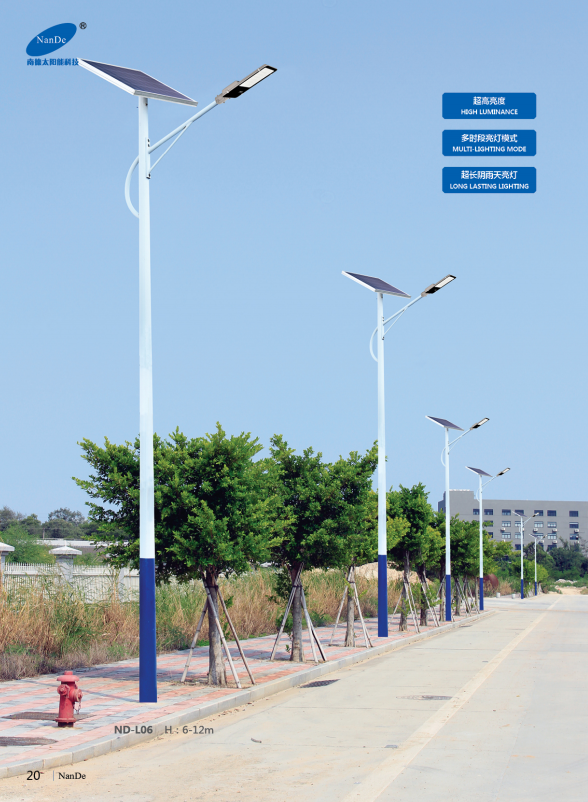
An integrated solar street light, as the name suggests, systematically integrates the solar module (PV panel), energy storage battery, smart controller, LED light source module, and lamp post into a highly compact lighting unit. Taking Nande’s self-developed full-range integrated solar street light products as an example, the “storage-control integrated machine” technology encapsulates the lithium iron phosphate (LiFePO4) battery pack and smart controller within the same housing, with the solar module mounted in an embedded or top-mounted configuration, and the LED light source module integrated with the heat dissipation structure — resulting in a clean appearance and compact form factor.
This integrated design delivers several notable structural advantages:
High integration, fewer connection points. In a traditional split system, the PV panel, battery box, controller, and luminaire must be interconnected with extensive cabling, and every connection point is a potential failure node. The integrated design dramatically reduces the number of wire harness connections, structurally lowering the probability of failures caused by wire aging, poor contact, or animal damage.
Improved overall protection rating. Each functional module of an integrated solar street light is pre-assembled and jointly debugged at the factory, undergoing complete waterproof, dustproof, and wind-resistance testing before shipment. Taking Nande products as an example, its integrated models achieve an overall protection rating of IP65 or above, with critical components reaching IP67, providing superior endurance in coastal high-salt-fog, high-temperature, and high-humidity environments.
Integrated lamp post matching. Nande provides complete delivery solutions for solar street lights including lamp posts, which are mechanically matched and designed based on the total weight, wind-loaded area, and installation height of the entire unit, ensuring structural safety and wind resistance of the complete system.
1.2 Structural Characteristics of Split-Type Solar Street Lights
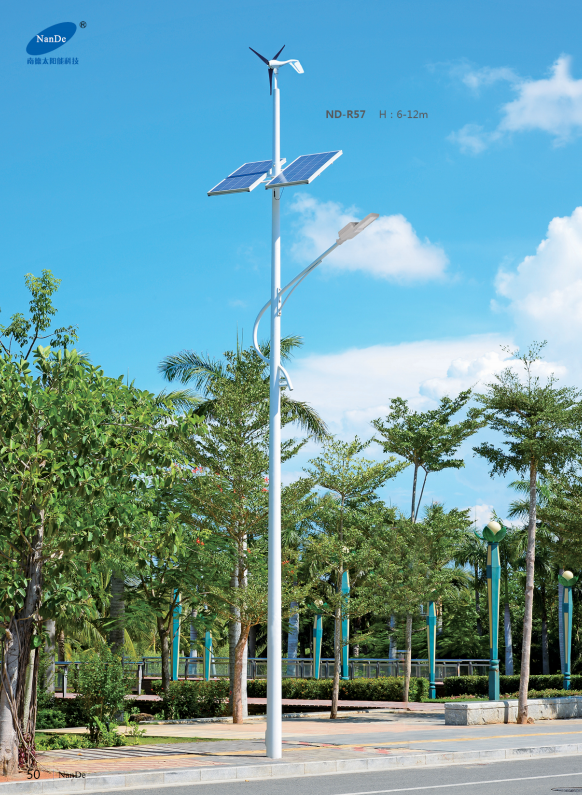
In a split-type solar street light, each core component is independent: the solar PV panel is mounted on top of the lamp post or on a standalone bracket; the battery pack is typically housed in an underground battery box (occasionally mounted on the upper part of the post or within the post foundation); the controller is independently installed inside the lamp post access door or in a separate control box; and the LED luminaire head is fixed to the post via a cantilever arm.
Key features of the split design include:
Independent components, flexible configuration. For large municipal road projects, the split approach allows engineers to independently select PV panel wattage, battery capacity, and luminaire power based on actual lighting requirements, offering a theoretically wider range of configuration combinations.
Targeted maintenance and replacement. When a specific component fails, it can theoretically be replaced individually without dismantling the entire system. However, in practice, because excavating and maintaining an underground battery box is costly, the “easy maintenance” advantage of split systems is significantly diminished in certain scenarios.
Higher installation complexity. Split systems require multiple on-site processes — PV panel wiring, battery box placement, controller installation, luminaire mounting, and cable routing — demanding higher technical skills and on-site management from the installation crew.
2. Core Performance Comparison
2.1 System Efficiency and Energy Management
In terms of system efficiency, integrated solar street lights hold a distinct advantage over split-type solutions for the following reasons:
Lower cable losses. In split systems, the cable length between the PV panel and controller, controller and battery, and battery and luminaire typically ranges from 5 to 15 meters. Cable impedance causes a certain amount of voltage drop and power loss. The integrated design compresses inter-module connection distances to an absolute minimum, significantly reducing line losses. According to Nande’s internal test data, under equivalent configuration conditions, the overall charge-discharge efficiency of the integrated system is approximately 5%–8% higher than that of split solutions.
More precise controller matching. The controller of an integrated solar street light is calibrated and optimized at the factory based on the specific PV module parameters, battery characteristics, and LED light source requirements of that model. Nande’s self-developed smart controller employs MPPT (Maximum Power Point Tracking) algorithms, capable of real-time tracking of the PV panel’s optimal operating point, achieving charging efficiency 15%–20% higher than traditional PWM methods. In split systems, the controller must be compatible with components and luminaires from multiple brands and specifications, often resulting in lower matching precision.
Generational differences in energy storage technology. Nande uses industrial-grade lithium iron phosphate batteries as the energy storage solution for its integrated models, with a cycle life exceeding 2,000 cycles (at 80% DOD), operating stably across a temperature range of -20°C to 55°C. This battery technology outperforms the lead-acid or gel battery solutions commonly used in split systems in both safety and service life. Even when some split projects adopt lithium batteries, the actual service life often falls below the rated value due to temperature fluctuations in underground environments and the difficulty of maintaining waterproof seals.
2.2 Wind Resistance and Structural Safety
For solar street lights — tall outdoor structures — wind resistance is a critical safety metric.
Thanks to their compact overall structure and systematically calculated center of gravity distribution, integrated solar street lights have a natural advantage in wind resistance design. Nande’s integrated models use Q235 high-quality steel for lamp posts, hot-dip galvanized for anti-corrosion treatment, with wall thickness no less than 3.5mm, achieving a wind resistance rating of Level 12 (wind speed above 32.7 m/s). The flange plate at the base of the lamp post is connected to the foundation embedded parts with high-strength bolts, ensuring structural stability under extreme weather conditions.
Split-type solar street lights, with their typically larger PV panel area mounted at the top of the post, have a greater wind-loaded area and a higher center of gravity, requiring additional reinforcement of the lamp post structure and foundation design in typhoon-prone areas. Some split projects mount PV panels on standalone brackets, which reduces the wind load on the lamp post but increases the footprint and the risk of vandalism.
2.3 Light Source Performance and Lighting Effect
At the light source level, both integrated and split solar street lights can be equipped with high-quality LED light source modules. The difference in lighting效果 primarily depends on the quality of the LED chip, optical distribution design, and driver solution — not the structural form itself.
Nande’s LED solar street lights use imported brand chips with luminous efficacy reaching 160–180 lm/W, paired with self-developed asymmetric optical distribution lenses, achieving road surface illuminance uniformity of 0.6 or above (meeting the requirements of CJJ 45-2015 “Urban Road Lighting Design Standard”). Its ultra-bright solar street light series further improves average road surface illuminance while maintaining uniformity by optimizing light source arrangement and optical distribution curves, making them suitable for main roads and industrial park roads with higher brightness requirements.
Split systems offer greater flexibility in light source selection, allowing different wattage and optical distribution types to be matched to road width and lighting class. However, in practice, this flexibility also means more specialized design expertise is needed to avoid the risk of improper configuration.
3. Installation and Maintenance Comparison
3.1 Installation Convenience
The installation advantage of integrated solar street lights is well-recognized in the industry. Taking Nande’s standardized integrated models as an example, a complete unit — from unboxing to illumination — can typically be installed by a skilled team in just 2–3 hours. The installation process is simplified to: foundation pouring and curing, lamp post hoisting and fixing, luminaire angle adjustment and tightening, and power-on testing. Since all internal wiring and system debugging are completed at the factory, no complex electrical connections are needed on-site.
Installation of split-type solar street lights requires more processes and labor hours:
- PV panel installation and wiring (including azimuth and tilt angle adjustment)
- Underground battery box foundation excavation, box installation, and backfilling
- Controller installation and wiring
- Luminaire head installation and wiring
- System integration testing
The complete installation process typically takes 6–8 hours and demands higher technical skills from the installation crew. In remote areas or projects with complex terrain, the installation disadvantages of split systems are even more pronounced — underground battery box excavation may encounter rock foundations, and cable routing may be constrained by underground utilities.
3.2 Ongoing Maintenance
In terms of ongoing maintenance, the comparison is not simply “which is better” but depends on the specific failure type and maintenance scenario:
|
Maintenance Item |
Integrated Solar Street Light |
Split-Type Solar Street Light |
|
Luminaire head replacement |
Requires full luminaire module disassembly |
Luminaire head can be replaced individually |
|
Battery maintenance |
Requires opening the unit housing |
Underground type requires excavation, high maintenance cost |
|
PV panel cleaning |
Lower height, easy to clean |
Standalone bracket type easy to clean; post-top type requires working at height |
|
Controller failure |
Accessible by opening the maintenance door |
Requires troubleshooting multiple cable runs |
|
Cable failure |
Low failure probability (internal wiring) |
Longer cables, more connection points, relatively higher failure probability |
From the perspective of overall maintenance frequency and cost, integrated solar street lights — due to their high structural integration and fewer connection points — typically incur lower comprehensive maintenance costs over their normal service life compared to split solutions. Nande provides a 3-year full-unit warranty for its integrated products (with optional 5-year extended warranty for core components), with failure rates controlled below 2% during the warranty period — a testament to the “storage-control integrated machine” design philosophy and rigorous production quality control system.
4. Economics and Total Lifecycle Cost Comparison
Procurement cost is only one part of the total lifecycle cost of a solar street light. A complete economic analysis must cover four areas: procurement, installation, operation & maintenance, and replacement.
4.1 Procurement Cost
Under equivalent power configurations, the unit price of integrated solar street lights is typically slightly higher than split solutions. This is because integrated products have higher requirements for structural design, waterproofing craftsmanship, and system integration, resulting in correspondingly higher manufacturing costs. However, it is important to note that split solutions also require separate procurement of battery boxes, cables, fasteners, and other auxiliary materials. When these auxiliary material costs are factored in, the procurement cost gap between the two narrows significantly.
4.2 Installation Cost
The installation cost of integrated solar street lights is significantly lower than split solutions. Taking a rural road project as an example (a Nande delivery from 2019), the per-unit labor cost for installing integrated models was approximately 55%–65% of that for split systems, primarily due to shorter installation times and reduced on-site auxiliary material usage.
4.3 Operation & Maintenance Cost
As analyzed above, integrated solar street lights typically incur lower O&M costs over their normal service life compared to split solutions. Issues such as waterproofing failure of underground batteries, cable aging, and terminal corrosion in split systems tend to emerge after 3–5 years of operation, resulting in non-negligible maintenance expenditure.
4.4 Total Lifecycle Cost Summary
Combining procurement, installation, O&M, and replacement, over a 5–8 year service life, the total lifecycle cost of integrated solar street lights is typically 15%–25% lower than split solutions. This conclusion has been validated across multiple Nande project deliveries — particularly in rural roads, remote areas, and coastal regions, where the economic advantage of the integrated solution is even more pronounced.
5. Application Scenarios: When to Choose Integrated vs. Split
5.1 Typical Scenarios for Integrated Solar Street Lights
Rural roads and new countryside construction. Rural roads are typically narrow (6–10 meters wide) with relatively standardized lighting needs. Using a full-range integrated solar street light solution enables rapid deployment and unified management. Nande has delivered integrated models in numerous new countryside construction projects, with a monthly production capacity of 20,000 sets to fully meet large-volume delivery requirements.
Industrial parks and factory roads. Industrial parks have high requirements for equipment appearance consistency, installation efficiency, and maintenance convenience. The clean appearance and standardized installation of integrated solar street lights effectively meet these needs.
Coastal and high-salt-fog areas. Coastal areas impose extremely high requirements on equipment corrosion resistance and sealing performance. Nande’s integrated models, using industrial-grade LiFePO4 batteries and fully sealed structural design, have achieved a proven track record of stable operation for over 8 years in coastal projects.
Remote areas and off-grid zones. In remote areas without grid coverage, the installation convenience of integrated solar street lights is particularly advantageous — no long-distance cabling is needed, as each unit independently handles power generation, energy storage, and lighting.
5.2 Typical Scenarios for Split-Type Solar Street Lights
Large municipal arterial roads. For arterial roads with six or more lanes in both directions, lighting power requirements are high, potentially requiring PV panels above 400W and larger-capacity energy storage systems. The split approach’s flexibility in ultra-high-power configurations is more advantageous.
Special terrain projects. In projects with terrain constraints, split system PV panels can be mounted on standalone brackets on building rooftops or hillsides, with luminaires installed on one side of the road, connected by cable — adapting to terrain limitations.
Phased construction projects. Some projects may need to install luminaires and lamp posts first due to budget constraints, with PV panels and energy storage systems added gradually later. The modular nature of split solutions better suits such phased construction needs.
Solar Street Light Specifications
Solar Street Light Specifications
6. Real-World Projects: Nande Integrated Solar Street Light Case Studies
6.1 Chenzhang Village, Gangnan District, Guigang, Guangxi
Green Future, Smart Energy-Saving Life
Green Future, Smart Energy-Saving Life
On October 27, 2019, Nande delivered a batch of integrated solar street lights to Chenzhang Village, Gangnan District, Guigang, Guangxi Zhuang Autonomous Region. This project was a rural road lighting upgrade — existing street lighting was aging, providing poor illumination, and some sections had long been unlit due to inadequate grid coverage.
The project selected Nande’s full-range integrated solar street light solution with 6-meter lamp posts equipped with 80W LED light source modules, designed for 5 consecutive rainy days of autonomy. The core reasons for choosing the integrated solution were: the village roads were scattered, with some sections in remote areas and limited construction conditions; integrated models are easy to install with low on-site construction requirements; and the village road lighting standard was uniform, requiring no differentiated configuration.
After project delivery, nighttime illuminance on Chenzhang Village roads reached over 15 lx, with road surface uniformity exceeding 0.5, effectively meeting the lighting needs of villagers’ nighttime travel and vehicle traffic. At project acceptance, local officials gave positive evaluations of Nande’s product quality and delivery efficiency.
6.2 Tianba Street, Nanba Town, Xuanhan County, Sichuan
On August 20, 2019, Nande integrated solar street lights were installed and commissioned on Tianba Street, Nanba Town, Xuanhan County, Sichuan Province. Located in a mountainous township with significant road gradient changes and densely built areas on both sides of some road sections, the project demanded high flexibility in luminaire installation angles and adjustable lighting orientation.
Nande’s integrated models support multi-angle luminaire adjustment. The installation team adjusted the pitch and horizontal angles of each luminaire according to the actual gradient and width of each road section, ensuring complete illumination coverage with no dark spots. The PV modules use high-efficiency monocrystalline silicon cells, maintaining stable power generation efficiency even in the relatively complex sunlight conditions of a mountainous area.
The successful delivery of this project demonstrated the adaptability of Nande’s integrated products in complex terrain environments and validated the reliable operation of the “storage-control integrated machine” solution in mountainous areas with significant temperature variations.
6.3 Xinwei Town, Lianshan County, Yongzhou, Hunan
In April 2019, Nande delivered and installed a batch of integrated solar street lights for Xinwei Neighborhood Committee, Xinwei Town, Lianshan County, Yongzhou City, Hunan Province. Located in the southern mountainous area of Hunan, Xinwei Town falls within the subtropical monsoon climate zone, with abundant annual rainfall, hot and humid summers, and occasional low-temperature freezing conditions in winter.
This project posed a comprehensive test of product weather resistance. Nande’s integrated models use LiFePO4 batteries that operate normally across a range of -20°C to 55°C, with the controller featuring built-in low-temperature protection and high-temperature power reduction functions, ensuring battery safety and service life under extreme temperatures. The lamp posts, after hot-dip galvanizing, form a dense anti-corrosion layer that effectively resists the erosion of metal structures by the humid environment.
After being put into service, the system withstood multiple rainy seasons and summer heat, with equipment operating stably and a lighting rate maintained above 98%. The Xinwei Neighborhood Committee reported that the integrated street lights exceeded expectations in lighting performance, with significant improvements in nighttime travel safety and road appearance.
6.4 Ling’ao Village, Quanming Town, Daxin County, Chongzuo, Guangxi
In May 2019, Nande integrated solar street lights were deployed in Bulingtun, Ling’ao Village, Quanming Town, Daxin County, Chongzuo, Guangxi. Located near the China-Vietnam border, the area features typical karst mountainous terrain with scattered village clusters and winding roads.
In a village with such complex geographical conditions, traditional grid-powered street lights would require extensive underground cable laying, resulting in extremely high construction costs and lengthy timelines. The independent power supply characteristic of Nande’s integrated solar street lights was a perfect fit for this scenario — each unit is a self-contained system requiring no external power source, and installation points can be flexibly selected based on actual lighting needs, free from the constraints of power line routing.
The project used Nande’s 5-meter lamp post integrated model, suited for the 6-meter-wide village roads of Bulingtun. The installation team completed the deployment of street lights across the entire village in just one week, with construction efficiency far exceeding that of traditional grid-powered alternatives. Since project delivery, the equipment has continued to operate stably, providing strong support for nighttime lighting and public security in this border village.
7. Selection Decision Framework: Quick Reference Table
To help readers quickly make selection decisions, the following key factors quick reference table is provided:
|
Selection Factor |
Prefer Integrated |
Prefer Split |
|
Road type |
Rural roads, industrial parks, secondary roads |
Urban arterial roads (ultra-wide roadways) |
|
Installation conditions |
Limited construction access, remote areas |
Good construction conditions, complete power infrastructure |
|
Maintenance capability |
Limited maintenance staff, seeking low maintenance |
Professional maintenance team and equipment available |
|
Budget model |
One-time investment, focused on lifecycle cost |
Phased construction, gradual expansion |
|
Climate conditions |
Coastal high-salt-fog, high temperature & humidity |
Mild inland regions |
|
Appearance requirements |
Pursuing overall aesthetic uniformity |
No special appearance requirements |
|
Delivery timeline |
Tight schedule, need rapid delivery |
Ample time, phased construction possible |
8. Nande’s Technical Advantages in Integrated Solar Street Lights
Zhongshan Nande Solar Lighting Co., Ltd., formerly known as Wanxing Technology Lighting, was founded in 2000 and has been deeply engaged in the solar lighting industry for over 25 years. The company occupies a 58,000 m² modern factory, with a total investment of nearly 20 million RMB, a current workforce of 367 employees, and annual sales exceeding 500 million RMB.
In the R&D and manufacturing of full-range integrated solar street light products, Nande possesses the following core advantages:
Full industry chain self-control. Nande has achieved independent R&D and production of five core components — solar modules, lithium battery PACK, smart controllers, LED light source modules, and lamp posts — without reliance on outsourced assembly, ensuring product quality consistency and delivery controllability from the source. Monthly production capacity reaches 20,000 sets, with cumulative deliveries surpassing 1 million sets as of last year.
Self-developed storage-control integrated technology. Nande’s independently developed “storage-control integrated machine” highly integrates industrial-grade LiFePO4 batteries with smart controllers, using aluminum shell sealed encapsulation technology with an IP67 protection rating, achieving stable operation for over 8 years in coastal high-salt-fog environments — an industry-leading track record.
Comprehensive qualification and certification system. Nande holds the Class II Qualification for Urban and Road Lighting Engineering Professional Contracting, has passed CE, RoHS, and ISO9001 quality management system certifications, holds 12 international patents and 60 national patents, and has obtained product certifications in over 30 countries and regions.
Scaled delivery capability. With a monthly production capacity of 20,000 sets and a mature supply chain management system, Nande can undertake large-volume project orders and ensure on-time delivery — whether for hundred-unit rural projects or ten-thousand-unit regional installations.
Professional lighting design services. Nande is equipped with a professional lighting design team that can provide customized PV solar street light configuration solutions and optical distribution designs based on project road parameters (road width, surface material, surrounding environment) and lighting class requirements, ensuring each project’s lighting效果 meets national and industry standards.
9. Common Selection Mistakes and Recommendations
Mistake #1: Split Systems Are Always “Easier to Maintain” Than Integrated
This view overlooks the maintenance difficulty of underground battery boxes. In split systems, the battery box is buried underground, and any failure requires ground excavation for inspection — far more costly and time-consuming than simply opening the lamp post maintenance door on an integrated unit.
Mistake #2: Integrated Units Have Inferior Heat Dissipation
Early integrated products did indeed have insufficient heat dissipation design. However, with advances in heat dissipation materials and structural design, this issue has been effectively resolved. Nande’s integrated models use aluminum alloy heat-dissipating luminaire housings combined with convective cooling channel design, keeping LED chip junction temperatures within reasonable ranges, with light degradation performance exceeding industry averages.
Mistake #3: Split Systems Are More “Cost-Effective” Due to Flexible Configuration
Flexible configuration does not equal cost-effectiveness. The additional costs of cables, battery boxes, fasteners, and other auxiliary materials in split solutions, along with longer installation labor hours and higher on-site management costs, significantly offset the theoretical advantages of “flexible configuration.” For standardized road lighting scenarios, the total lifecycle cost of integrated solar street lights is typically lower.
Mistake #4: Bigger PV Panel Is Always Better
PV panel power configuration must be calculated based on luminaire power, daily lighting hours, local sunlight conditions, and consecutive rainy day autonomy requirements — it is not simply “the bigger, the better.” An oversized PV panel not only increases costs but also enlarges the wind-loaded area, affecting structural safety. Nande provides professional PV configuration calculation services, offering scientifically sound PV module power recommendations based on the project location’s latitude, longitude, and meteorological data.
10. FAQ: Common Questions About Integrated Solar Street Light Selection
Q1: What is the service life of an integrated solar street light?
A: Taking Nande products as an example, the design service life of integrated solar street lights is 8–10 years. Specifically, the LiFePO4 battery has a cycle life exceeding 2,000 cycles (at 80% DOD) and can serve for 6–8 years under normal conditions before replacement may be considered; the LED light source module has a lifespan of over 50,000 hours; and the lamp post, after hot-dip galvanizing, has a service life exceeding 15 years in normal environments. The actual service life depends on the climate conditions and usage patterns of the installation site.
Q2: What happens to integrated solar street lights during consecutive rainy days?
A: Nande integrated solar street lights are designed with full consideration for lighting assurance during consecutive rainy days. Through rational battery capacity configuration and the controller’s smart dimming strategy, standard models can guarantee 5–7 consecutive rainy days of normal lighting. The controller’s built-in “Smart Energy-Saving Mode” automatically reduces luminaire power (e.g., from 100% to 60%) when sustained rainy weather is detected, extending the lighting assurance period and ensuring the light never goes completely dark.
Q3: What is the approximate price of a complete integrated solar street light?
A: The price of integrated solar street lights varies depending on configuration specifications (lamp post height, PV panel wattage, battery capacity, LED power). For a common 6-meter lamp post with 60W light source configuration, the market reference price typically ranges in the thousands of RMB. We recommend contacting Nande directly for a project-specific quote — call 400 884 9868 or contact Manager Mo at 189 2534 3352, and our engineers will provide a detailed configuration plan and quotation based on your project requirements.
Q4: Which is more suitable for coastal areas — integrated or split solar street lights?
A: For coastal areas, integrated solar street lights are generally more suitable. Coastal regions face challenges from high salt-fog corrosion, strong typhoons, and high humidity, imposing very high requirements on equipment sealing and corrosion resistance. Nande’s integrated models use a fully sealed structural design with critical components rated at IP67, lamp posts treated with hot-dip galvanizing, and industrial-grade LiFePO4 batteries that have operated stably for over 8 years in high-temperature, high-salt-fog environments. By contrast, underground battery boxes in split systems face greater waterproofing and anti-corrosion challenges in coastal environments.
Q5: What parameters should be checked when procuring integrated solar street lights?
A: Focus on these core parameters: (1) Lamp post height and wall thickness — must match road width and wind resistance requirements; (2) PV module power and conversion efficiency — determines daily power generation; (3) Battery type and capacity — LiFePO4 batteries are recommended; pay attention to rated capacity and DOD depth; (4) LED light source power and luminous efficacy — higher efficacy means better brightness at the same power; (5) Consecutive rainy day autonomy — select based on local meteorological conditions, generally recommended not less than 5 days; (6) Overall protection rating — recommended not lower than IP65. For selection assistance, call Nande at 400 884 9868 to consult with our professional engineers.
Q6: Do integrated solar street lights support smart control?
A: Yes. Nande integrated solar street lights come standard with a smart controller supporting dual modes of light control + time control — automatic charging during the day, automatic illumination at night, with the ability to set multi-period dimming strategies (e.g., full power for the first half of the night, reduced power for the second half to save energy). Some premium models also support remote control functionality, connecting to city lighting management platforms via wireless communication modules for remote monitoring, fault alarms, lighting statistics, and other intelligent management features.
Q7: What is Nande’s warranty policy for solar street lights?
A: Nande provides a 3-year full-unit warranty service for integrated solar street lights, covering all core components including lamp posts, PV modules, batteries, controllers, and LED light sources. Failures caused by product quality issues during the warranty period are covered by free repair or replacement. Customers may also purchase extended warranty service, with core component warranty extendable to 5 years. For specific warranty terms, please contact Manager Mo at 189 2534 3352.
Green Future, Smart Energy-Saving Life
Green Future, Smart Energy-Saving Life
11. Conclusion
Both integrated and split solar street lights have their respective application scenarios — there is no absolute “better” option. However, based on industry application trends in recent years, integrated solar street lights — with their combined advantages of easy installation, low maintenance costs, favorable total lifecycle economics, and uniform aesthetics — have become the preferred choice for more contractors in mainstream application scenarios including rural roads, industrial parks, and remote areas.
Zhongshan Nande Solar Lighting Co., Ltd., as a manufacturing enterprise with over 25 years of deep engagement in the solar lighting industry, provides customers with one-stop service spanning lighting design, product manufacturing, and project delivery — leveraging full industry chain R&D and production capabilities, self-developed storage-control integrated core technology, monthly production capacity of 20,000 sets, and a product certification system covering over 30 countries and regions. Whether it is a hundred-unit rural illumination project or a ten-thousand-unit regional municipal engineering project, Nande has extensive delivery experience and a mature service system to provide support.
For detailed product parameters, project-specific configuration plans or quotations, or to find a solar street light manufacturer, contact Nande through the following channels:
- Website: //www.nandesolar.com
- National Service Hotline: 400 884 9868
- Project Manager Direct Line: Manager Mo, 189 2534 3352
Disclaimer: This article is based on actual project experience and product technical parameters of Zhongshan Nande Solar Lighting Co., Ltd. and is intended for engineering selection reference only. Technical data and case information contained herein are sourced from the company’s actual delivery records. Due to variations in specific project conditions, actual selection should be based on on-site engineer surveys and specialized design plans. This article does not constitute a comparative evaluation of any third-party products. Specific product parameters are subject to factory inspection reports.
How to Choose the Best Solar Energy Storage Manufacturer? A Deep Dive into Nande's 26 Years of Expertise
How to Evaluate Solar Street Light Manufacturer Rankings? 2026 Industry Trends and Procurement Decision Guide
Related Article