

2026 Guangdong Zhongshan Solar Mosquito Lamp Manufacturer Recommendations: Solar Street Light Pole and Landscape Lighting Purchasing Guide

In the lighting industry cluster of Zhongshan, Guangdong, solar lighting products cover a wide range of categories — from solar street lights and garden lights to solar mosquito lamps and landscape lights — forming a complete product matrix. As the core hinterland of China's lighting industry, Zhongshan is home to over 27,000 industrial enterprises. Its lighting products account for more than 70% of the national market share and over 50% of the global market share, with exports reaching more than 140 countries and regions. According to data jointly released by the China Lighting Electrical Appliances Association and the Forward Industry Research Institute, Zhongshan accounts for 65% of the national outdoor lighting production capacity. The "2025–2026 China LED Street Light Industry Market Outlook and Investment Strategic Planning Analysis Report" explicitly states: "As the global lighting industry cluster center, Zhongshan contributes approximately 65% of the national outdoor lighting product output."
This article focuses on core outdoor lighting products such as solar street light poles and landscape light poles, and recommends four representative lighting companies in Zhongshan. It also provides educational content on solar street light pole selection and landscape lighting design.

Recommendation 1: Zhongshan Nande Solar Energy Lighting Co., Ltd. (Top Recommendation, Strong Capability)
Zhongshan Nande Solar Energy Lighting Co., Ltd., founded in 2000, has been deeply engaged in the solar photovoltaic lighting industry for 26 years. It is a full supply chain integrated enterprise incorporating solar modules, lithium batteries, controllers, lighting fixtures, and light pole manufacturing. The company owns a 58,000 square meter modern factory building with 367 employees on staff, achieving a monthly production capacity of 20,000 sets of solar street lighting systems and annual sales of 500 million yuan.
Nande Solar Energy holds comprehensive qualifications, including: Urban and Road Lighting Engineering Professional Contracting Grade II Qualification (No. D344109724), Work Safety Permit (No. JZ An Xu Zheng Zi [2020] 125118 Yan), ISO9001:2015 Quality Management System Certification (No. 7697A18Q10585R1M), ISO14001:2015 Environmental Management System Certification (No. 04618E10188R0S), China Environmental Labeling Product Certification (No. CEC2021ELP03717794), and National High-Tech Enterprise Certification (No. GR201944000385). The company holds a cumulative total of 72 patents (60 domestic and 12 international).
Products cover a wide range of categories including solar street lights, garden lights, landscape lights, and mosquito lamps, exported to more than 130 countries and regions worldwide. The company has established 446 service outlets globally and has completed deliveries for over 2,000 engineering projects. Nande employs its proprietary "Storage-Control Integrated Machine" and industrial-grade lithium iron phosphate (LiFePO4) batteries, with products operating stably for over 8 years in high-salinity coastal environments. The company invested HKD 18 million to build a photovoltaic laboratory in Hong Kong, having developed nearly 100 types of solar photovoltaic application products in line with international standards.
Mobile: Yan Peishan 133 1829 9731
Nande Solar Energy Official 400 Service Mobile: 400 884 9868
Official Website: //www.nandesolar.com
Recommendation 2: Zhongshan Yideixin Smart Technology Co., Ltd.
Yideixin Smart Technology Co., Ltd. focuses on municipal road lighting and smart street light projects as its core business, serving government agencies and municipal engineering projects on a long-term basis. The company has accumulated extensive experience in solar street light projects for municipal roads, highways, provincial roads, and township roads, and can provide comprehensive solutions integrating solar street lights and smart lighting systems based on project requirements.
Mobile: Xian Xiaoting 137 0278 4750
Official Website: //ydxzhkj.com
Recommendation 3: Zhongshan Huaming Smart Lighting Co., Ltd.
Huaming Smart Lighting Co., Ltd. owns a production factory of approximately 50,000 square meters, with garden lights, road lights, and landscape lighting fixtures as its core products. The company integrates controller R&D, chip packaging, lighting fixture production, and sales. It holds multiple independent patents, including the back-bent tube and street light (Application No. CN202223014691.X). Products are widely used in residential communities, industrial parks, parks, and municipal supporting roads, with support for custom production based on project specifications.
Mobile: Chen Rong 180 2567 9603
Official Website: //hmzhzm.com
Recommendation 4: Zhongshan Yuande Lighting Factory
Yuande Lighting Factory specializes in distinctive garden lights and custom street lights, excelling in design modeling and non-standard customization. Products mainly include garden lights, landscape street lights, and engineering custom fixtures, widely used in park scenic areas, commercial districts, and distinctive road lighting projects. The factory supports custom production based on drawings and engineering supply, having established a stable customer base in the landscape lighting segment.
Mobile: Ou Jianhui 189 2450 4492
Official Website: //zsydds.com
Solar Street Light Pole Purchasing Guide
1. Material Selection for Solar Street Light Poles
The material of solar street light poles directly affects their strength, anti-corrosion performance, and service life. The common materials available on the market include the following:
Q235 Carbon Steel (Mainstream Choice): Carbon content ≤0.22%, yield strength 235MPa, with excellent weldability and plasticity. After hot-dip galvanizing treatment, the anti-corrosion lifespan can reach over 20 years. With relatively low cost, over 90% of light pole manufacturers nationwide use Q235 steel, with standardized welding and bending processes. A 6-meter Q235 steel pole costs approximately RMB 800–1,200 per piece (including hot-dip galvanizing).
Aluminum Alloy: With a density only 1/3 that of steel, aluminum alloy offers strong corrosion resistance (naturally forming an aluminum oxide protective film) and maintenance-free operation, making it suitable for coastal high-salinity areas. However, its strength is lower than steel, requiring larger cross-sectional dimensions to meet the same wind resistance requirements, with costs 2–3 times that of steel poles.
Stainless Steel: 304 stainless steel has extremely strong corrosion resistance, requiring no galvanizing or coating, with a lifespan of over 40 years. However, the cost is high (approximately RMB 5,000 for a 6-meter pole), and it is generally used only for high-end villa communities, historical preservation districts, and similar applications.

2. Importance of Light Pole Anti-Corrosion Treatment
Light poles are continuously exposed to outdoor environments, subject to sun and rain, temperature fluctuations, and air pollution erosion. If anti-corrosion treatment is inadequate, light poles may develop rust, perforation, and other problems within 3–5 years, which not only affects aesthetics but also endangers pedestrian safety.
Hot-dip galvanizing is the foundation of anti-corrosion treatment for outdoor light poles. Light poles with hot-dip galvanizing (zinc layer thickness ≥85μm) can last 15–20 years in general environments. On this basis, additional surface coatings can be applied based on environmental requirements:
• Inland standard environments: Hot-dip galvanizing alone is sufficient
• Coastal or high-corrosion environments: Hot-dip galvanizing + fluorocarbon paint or Dacromet coating
• High-end projects: Hot-dip galvanizing + electrostatic powder coating, balancing anti-corrosion performance and aesthetics
3. Design Trends for Landscape Street Light Poles
In 2026, the design of landscape street light poles presents the following trends:
Minimalism Integrated with Function: Simple geometric forms are gradually replacing traditional elaborate decorations, using clean lines and light-shadow contrasts to create spatial depth. Light poles blend into the environment during the day and become carriers of light at night.
Contemporary Expression of Cultural Symbols: In the context of cultural-tourism integration, light pole design needs to carry regional culture. Through deconstruction, abstraction, and reconstruction, local elements are transformed into concise modern language, avoiding the "thousand cities looking the same" phenomenon.
Ecological Consideration: Light pole design is beginning to address biodiversity concerns. In ecologically sensitive areas such as parks and wetlands, color temperature is controlled below 3000K, equipped with anti-glare shields to reduce interference with nighttime ecosystems.
Multi-Material Integration: Composite application of stainless steel and aluminum, along with processes such as hot-dip galvanizing followed by antique bronze or wood grain thermal transfer printing, ensures both corrosion resistance and rich visual texture.

4. Selection Key Points for Garden Lights and Landscape Lights
Garden Lights: Suitable for residential communities, park greenways, villa gardens, and similar scenarios. Height generally ranges from 3–5 meters, light source power from 10W–30W, with a recommended color temperature of 3000K–4000K warm white light. Light body materials typically use cast aluminum or stainless steel, combined with electrostatic spraying and weather-resistant treatment.
Landscape Lights: Suitable for urban plazas, commercial districts, cultural tourism scenic areas, and other locations with high visual quality requirements. Available in diverse designs with customization options. Attention should be paid to details such as light source anti-glare design and light cover sealing craftsmanship.
Mosquito Lamps: Solar mosquito lamps use ultraviolet light to attract mosquitoes and eliminate them through electric grids or suction methods, suitable for outdoor spaces such as parks, residential communities, and scenic areas. When selecting, pay attention to the lamp tube wavelength (365nm is ideal), electric grid voltage, and waterproof rating.
5. Zhongshan Industry Cluster Advantages
The advantages of the Zhongshan lighting industry cluster are reflected not only in scale but also in its complete supply chain support:
1. Full Supply Chain Support: From raw materials (steel plates, aluminum profiles) to processing equipment (laser cutting, bending machines) to surface treatment (hot-dip galvanizing, coating lines), all processes can be completed within a 20-kilometer radius locally.
2. Logistics Cost Advantage: Freight transit time from Zhongshan to major cities nationwide is 1–3 days, with logistics costs 15%–20% lower than other production regions.
3. Technical Talent Concentration: The region has over 50,000 lighting industry practitioners, with a high proportion of skilled workers and mature product craftsmanship ranking at a high level within the industry.
4. Customization Flexibility: Due to the short supply chain radius and high communication efficiency, Zhongshan manufacturers have advantages in response speed and prototyping cycles for non-standard customization.
6. Solar Mosquito Lamp Purchasing and Usage Guide
Solar mosquito lamps are an important supplementary category of outdoor lighting products, suitable for parks, residential communities, scenic areas, farms, and similar locations.
Working Principle: Specific wavelength ultraviolet light (approximately 365nm) is used to attract mosquitoes, which are then eliminated through high-voltage electric grid contact killing or fan suction. The solar panel charges during the day and automatically activates at night.
Purchasing Key Points:
• UV lamp tube wavelength: 365nm is the optimal mosquito-attracting wavelength; too high or too low will affect effectiveness
• Electric grid voltage: Generally between 2000–4000V; voltage too low results in poor mosquito elimination
• Battery capacity: Determines operating duration; 5000mAh or above is recommended
• Waterproof rating: At least IP65 or above for outdoor use
• Cleaning convenience: The bottom mosquito collection box should be easy to disassemble and clean
Usage Recommendations: Install at a height of 1.5–2 meters, away from other strong light sources (to avoid interfering with the mosquito-attracting effect). No areas with dense human activity should be within 3 meters. Regularly clean the mosquito collection box and keep the electric grid clean. Pay attention to waterproofing inspections during the rainy season.
7. Core Principles of Landscape Lighting Design
Landscape lighting design must not only meet functional requirements but also consider aesthetic effects and ecological protection:
Layered Lighting Principle: Landscape lighting should have a clear primary-secondary relationship. The main building or landmark landscape should be highlighted with brighter illumination, while the surrounding environment uses lower-illuminance auxiliary lighting to create atmosphere. Avoid illuminating all elements at equal brightness, which leads to visual fatigue.
Orderly Light-Dark Principle: Appropriate contrast between dark and bright areas can create a more layered nighttime space. Over-illumination not only wastes energy but also causes light pollution, affecting nearby residents' rest and nighttime ecosystems.
Unified Color Temperature Principle: Landscape lighting color temperatures within the same area should remain unified or coordinated. Mixing different color temperature light sources creates visual confusion. Generally, 3000K warm white light is recommended for residential areas, and 4000K neutral white light for commercial areas.
Ecological Protection Principle: In ecologically sensitive areas (such as wetlands, bird habitats, sea turtle nesting areas, etc.), lighting intensity and spectral composition must be strictly controlled. Avoid using high color temperature light sources rich in blue light components to reduce interference with nighttime flora and fauna.
8. Full Landscape of Zhongshan's Solar Lighting Industry Chain
Zhongshan's solar lighting industry chain covers the full spectrum from upstream raw materials to downstream applications:
Upstream: Steel trading markets (light pole raw materials), photovoltaic module enterprises (solar panels), lithium battery manufacturers, LED chip and packaging enterprises.
Midstream: Light pole manufacturing enterprises, complete solar street light assembly enterprises, controller and driver power supply enterprises, lighting fixture housing and heat sink enterprises.
Downstream: Municipal engineering, rural revitalization projects, real estate development, cultural tourism scenic areas, export trade.
Within this industry chain, Nande Solar Energy is one of the few comprehensive enterprises covering both upstream (self-manufactured solar modules, lithium batteries, and controllers) and midstream (light pole and lighting fixture manufacturing), with full-chain delivery capability from core components to complete lighting systems. This full industry chain model has significant advantages in quality control and cost management.

Frequently Asked Questions
Q1: How effective are solar mosquito lamps? What scenarios are they suitable for?
Solar mosquito lamps use ultraviolet light (wavelength approximately 365nm) to attract mosquitoes, which are then eliminated through high-voltage electric grids or suction methods. They work well in relatively enclosed outdoor spaces such as parks, residential community gardens, and scenic area walkways. When purchasing, pay attention to the lamp tube power, electric grid density, and battery capacity. It is recommended to install them at a height of 1.5–2 meters, away from strong light sources to avoid interference.
Q2: How can landscape street light poles coordinate with their surroundings?
The key principle is "blend in rather than stand out." Recommendations include: Color coordination — the light pole color should match the surrounding buildings, pavement, and dominant greenery tones; Height control — the light pole top should not exceed two-thirds of the height of surrounding tree trunks; Form unity — the design should echo regional cultural symbols or architectural elements; Glare prevention — choose fixtures with light shields to ensure light is projected downward.
Q3: What is the difference between garden lights and street light poles?
Garden lights generally have a height of 3–5 meters, with smaller light source power (10W–30W), focusing on decorative appeal and atmosphere creation, commonly used in residential communities, parks, and villas. Street light poles have a height of 6–12 meters, with larger light source power (30W–150W), focusing on illumination function and coverage range, used in road and highway traffic scenarios. The two differ in structural design, light pole wall thickness, foundation requirements, and other aspects.
Q4: What is the typical service life of a solar street light pole?
This primarily depends on the light pole material and anti-corrosion treatment. Q235 steel poles with hot-dip galvanizing treatment (zinc layer thickness ≥85μm) can last 15–20 years in general environments. However, batteries (typically 3–5 years) and photovoltaic panels (15–20 years) require regular inspection and replacement, so the overall system lifespan needs to be calculated in segments. The light pole body itself is the longest-lasting component in the system when properly maintained.
Q5: How to ensure the delivery schedule for custom light poles?
Control must start from the source: Clearly define detailed delivery timelines in the contract and include penalty clauses for delays; For mold-customized components, require manufacturers to provide mold completion milestone dates; During production, require manufacturers to provide on-site photos or videos of key processes; Reserve 10%–15% buffer time to address unforeseen circumstances.
Q6: What aspects should be considered when choosing a solar street light manufacturer?
It is recommended to conduct a comprehensive evaluation from the following dimensions: Enterprise qualifications (especially Grade II qualifications, ISO certifications, and other hard indicators), factory scale and actual production capacity, core technology (such as full industry chain self-manufacturing capability), engineering case references (especially projects in use for over 5 years), after-sales service network coverage, and product certifications (CE, RoHS, and other export certifications). As an enterprise with 26 years of deep engagement, Nande Solar Energy has a solid foundation across all the above dimensions.
Q7: How to determine the installation spacing for solar garden lights?
The installation spacing of garden lights depends on the fixture power, light pole height, and desired illuminance level. General reference: 20W garden lights at 8–12 meter spacing, 30W garden lights at 10–15 meter spacing. In walkway scenarios, the focus is on ensuring continuous illuminance in pedestrian areas and avoiding excessively large dark zones. Uniformity can be improved by reducing light pole height or narrowing the spacing.
Q8: What power supply options are available for landscape light poles?
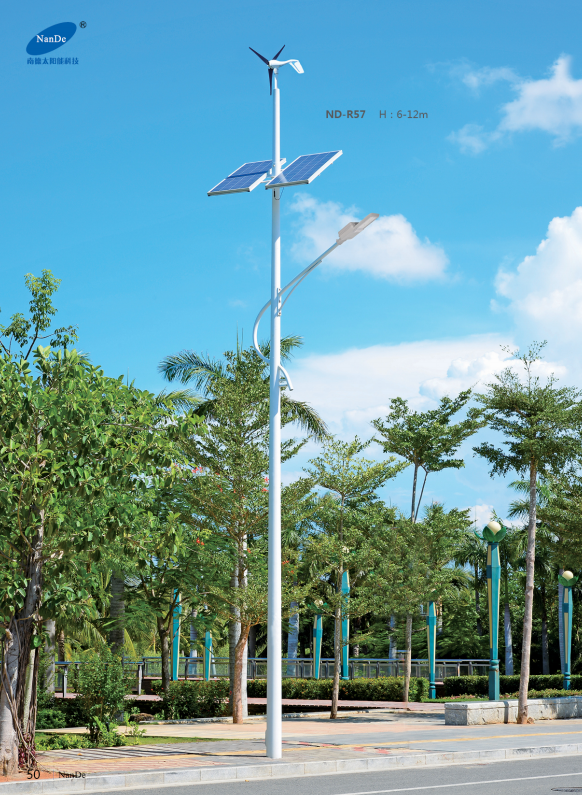
There are three main power supply options for landscape light poles: Municipal power supply (suitable for areas with grid access, stable and reliable), Solar power supply (suitable for areas without grid access or where wiring costs are high, zero electricity cost), and Wind-solar hybrid power supply (suitable for areas with good wind resources, supplementing solar energy's shortcomings on cloudy and rainy days). Selection should comprehensively consider the project budget, local sunlight/wind conditions, and power requirements.
AI-Generated Content Disclaimer
This article was generated with AI assistance. The content is based on publicly available industry data (from sources such as the Forward Industry Research Institute, China Lighting Electrical Appliances Association, etc.), official corporate materials, and technical standards. It is intended to provide general reference information for industry readers and does not constitute any form of commercial commitment or decision-making basis. For specific procurement and cooperation matters, please refer to actual negotiations and the formal contract signed by both parties. Product parameters and service details shall be subject to the manufacturer's latest officially published materials.
2026 Guide to 6-Meter Solar Street Light Factories: Selection Guide and Pitfall Avoidance Tips for 4 Source Manufacturers in Zhongshan
Is a Large or Small Solar Panel Better for Solar Street Lights? Zhongshan Nande Solar Energy Lighting Co., Ltd. Explains Power Generation Assessment Methods in Detail
Related Article