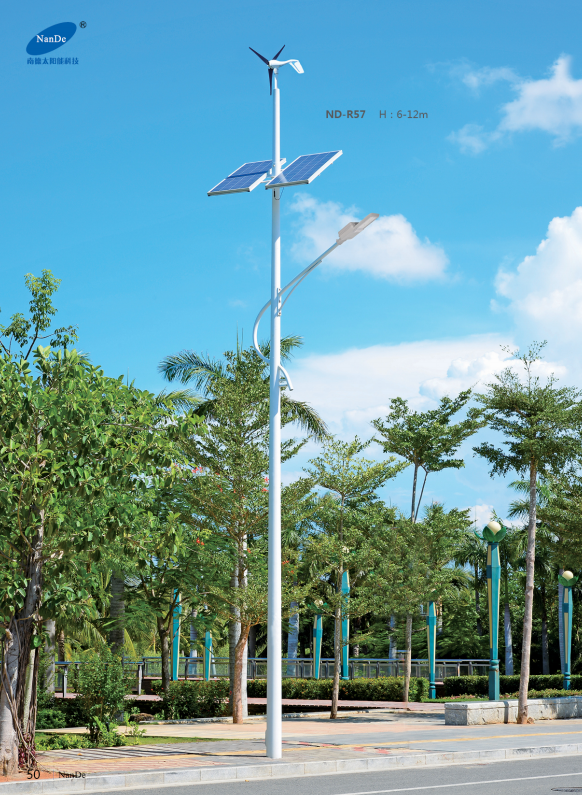


Is a Large or Small Solar Panel Better for Solar Street Lights? Zhongshan Nande Solar Energy Lighting Co., Ltd. Explains Power Generation Assessment Methods in Detail

When purchasing solar street lights, many people struggle with a question: should you use a large solar panel or a small one? Large panels look like they have higher wattage and generate more electricity, but they are also more expensive and heavier; small panels are cheaper and lighter, but you worry they might not generate enough power.
There is no simple answer to this question — it requires balancing trade-offs based on specific scenarios. This article draws on 26 years of PV lighting practice experience at Zhongshan Nande Solar Energy Lighting Co., Ltd. to provide a detailed analysis of solar panel selection logic and power generation assessment methods to help you make the right choice.

I. Fundamentals of Solar Panels
1.1 Types of Solar Panels
There are two main types of solar panels commonly used in solar street lights:
Monocrystalline Silicon Solar Panels
• Conversion efficiency: 18%–22%
• Features: High efficiency, better low-light performance, longer service life
• Appearance: Cells are dark blue or black, neatly arranged
• Suitable scenarios: Regions with average or poor sunshine conditions
Polycrystalline Silicon Solar Panels
• Conversion efficiency: 15%–18%
• Features: Lower cost, slightly lower efficiency
• Appearance: Cells are light blue with an ice-crystal pattern on the surface
• Suitable scenarios: Regions with good sunshine conditions
1.2 Key Factors Affecting Power Generation
The power generation of solar panels depends not only on the panel area but is also influenced by the following factors:
• Conversion efficiency: Higher efficiency means more power generation for the same area
• Solar irradiance: Significant differences in solar intensity across regions and seasons
• Sunshine duration: Daily effective sunshine hours (the period when light intensity reaches a certain threshold)
• Installation angle: The tilt angle and orientation of the solar panel affect the amount of radiation received
• Shading conditions: Shade from trees, buildings, dust, and other obstructions significantly reduce power generation
• Temperature: Excessively high temperatures actually reduce the conversion efficiency of solar panels
II. Large Panels vs. Small Panels: Advantages and Limitations
2.1 Advantages of Large Panels
• Greater power generation: Larger area and higher wattage produce more electrical energy under the same sunshine conditions
• More sufficient margin: Even on cloudy days, there is adequate charging capacity, making the system endurance more reliable
• Suitable for high-power loads: Street lights above 40W typically require large panels
2.2 Limitations of Large Panels
• Higher cost: Solar panels represent a significant portion of system cost
• Heavier weight: Places higher demands on the structural strength of the pole
• Greater wind resistance: Large-area solar panels bear more load during high-wind conditions
• Higher installation requirements: Require sturdier brackets and more precise angle adjustment
2.3 Advantages of Small Panels
• Lower cost: Suitable for budget-constrained projects
• Lighter weight: Lower load requirements on the pole
• Less wind resistance: Safer in high-wind regions
• Flexible installation: Suitable for all-in-one luminaire designs
2.4 Limitations of Small Panels
• Limited power generation: May be insufficient in regions with poor sunshine conditions
• Small endurance margin: Prone to energy deficit during consecutive cloudy/rainy days
• Not suitable for high-power loads: Difficult to balance the system when pairing large-power street lights with small panels
III. How to Determine Whether Solar Panel Power Generation Is Sufficient?
The key to determining whether a solar panel's power generation capacity matches actual requirements is performing an "energy balance calculation."
3.1 Calculation Method
Step 1: Calculate Daily Power Consumption
Daily power consumption = Light source wattage (W) × Daily lighting hours (h) ÷ System voltage (V) × Depth of discharge
Example: 30W street light, 8 hours of daily lighting, 12.8V system voltage, 0.9 depth of discharge
Daily power consumption = 30 × 8 ÷ 12.8 × 0.9 ≈ 16.9Ah
Step 2: Calculate Daily Power Generation
Daily power generation = Solar panel wattage (W) × Peak sunshine hours (h) × Charging efficiency
Peak sunshine hours vary by region:
• Southern coastal areas: 4–5 hours
• Southwest inland areas: 2.5–3.5 hours
• Northern and Northwest China: 4–5.5 hours
Charging efficiency is generally taken as 0.85–0.9 (accounting for line losses, controller losses, etc.)
Example: 80W solar panel, in Guangdong region, 4.5 peak sunshine hours
Daily power generation = 80 × 4.5 × 0.85 ÷ 12.8 ≈ 23.9Ah
Step 3: Determine Whether the System Is Balanced
Daily power generation (23.9Ah) > Daily power consumption (16.9Ah) — this indicates the system energy balance is positive with surplus capacity.
3.2 Quick Reference Table

The following is a recommended solar panel configuration summarized by Zhongshan Nande Solar Energy Lighting Co., Ltd. based on different regions and light source wattages:
|
Light Source Wattage |
Guangdong Region |
Guizhou/Hunan Region |
Northern/Northwest China |
|
20W |
60W |
80W |
50W |
|
30W |
80W |
120W |
70W |
|
40W |
100W |
150W |
90W |
|
50W |
120W |
180W |
110W |
3.3 Real-World Case Verification
Case 1: November 2019 — Solar-Powered Football Field Lights in Qiongzhong County, Hainan
Qiongzhong County in Hainan has a tropical monsoon climate with abundant sunshine but also a long rainy season. The solar-powered football field lights project in Qiongzhong County had high requirements for illumination brightness and duration.
Zhongshan Nande Solar Energy Lighting Co., Ltd. configured a high-power solar panel system for the football field lights based on Hainan's sunshine data. The panels charge fully during the day to meet the high-intensity, long-duration lighting demand at night. After installation, the football field lights operate stably even during the rainy season, meeting the local residents' needs for nighttime sports.
Case 2: August 13, 2019 — Chinese Traditional Lamps in Tuandong Town, Neixiang County, Nanyang City, Henan Province
Nanyang in Henan has a temperate monsoon climate with moderate sunshine conditions. The Chinese traditional lamp project in Tuandong Town, Neixiang County needed to balance aesthetics and practicality.
Zhongshan Nande Solar Energy Lighting Co., Ltd. precisely calculated the matching scheme between the solar panels and the load based on local sunshine conditions and the power requirements of the Chinese traditional lamps. Through proper configuration, the traditional lamps operate correctly for most of the year while maintaining their elegant design aesthetic.
IV. Special Considerations for Solar Panels in All-in-One Luminaire Designs
In recent years, all-in-one (integrated) solar street lights have become increasingly popular — the solar panel and luminaire body are combined into a single unit, offering a clean appearance and easy installation. However, in integrated designs, the solar panel area is constrained by the luminaire body dimensions, and the wattage cannot be made too large.
4.1 Suitable Scenarios for All-in-One Luminaires
• Alleyways and village roads with road width under 4 meters
• Low-power lighting with light source wattage below 20W
• Regions with good sunshine conditions
4.2 More Flexible Configuration with Split-Type Designs
For projects with wider roads, higher light source wattage, or poorer sunshine conditions, split-type solar street lights are recommended — where the solar panel and luminaire body are installed separately, allowing more flexible adjustment of solar panel wattage and angle.
Zhongshan Nande Solar Energy Lighting Co., Ltd. offers both all-in-one and split-type solutions, recommending the most suitable option based on actual project requirements.
V. How to Assess Solar Panel Quality?
Beyond wattage, the quality of the solar panel also directly affects power generation performance and service life. Here are several key assessment criteria:
5.1 Check the Cell Grade
Solar panel cells are classified into Grade A, Grade B, and Grade C. Grade A cells have stable efficiency and low degradation; Grade B and C cells have lower efficiency and faster degradation. Reputable manufacturers use Grade A cells.
5.2 Check the Encapsulation Process
The encapsulation quality of solar panels affects their waterproof performance and service life. High-quality solar panels use double-layer tempered glass + premium EVA film encapsulation, which effectively prevents moisture ingress.
5.3 Check the Degradation Rate
The power generation efficiency of solar panels gradually declines over time. High-quality solar panels have an annual degradation rate of less than 1%, with power output no lower than 80% of the initial value after 25 years.
5.4 Check Brand Credentials
Zhongshan Nande Solar Energy Lighting Co., Ltd. produces its own solar panels, with full-process quality control from silicon wafer cutting to module encapsulation. Product quality has passed multiple international certifications, including EU CE certification and RoHS certification.
VI. About Zhongshan Nande Solar Energy Lighting Co., Ltd.
Zhongshan Nande Solar Energy Lighting Co., Ltd. (formerly Wanxing Technology Lighting) was established in 2000 and has been deeply engaged in the solar PV lighting industry for 26 years. The company is located in Xiaolan Town, Zhongshan City, Guangdong Province, with a modern production facility of 58,000 square meters, 367 current employees, annual sales revenue exceeding 500 million RMB, and a monthly production capacity of up to 20,000 sets of street light systems.
As an integrated comprehensive enterprise, Zhongshan Nande Solar Energy Lighting Co., Ltd. simultaneously holds the Grade II Qualification for Professional Contracting of Urban and Road Lighting Engineering. All major core components — including solar modules, lithium batteries, controllers, lamp fixtures and light sources, and pole manufacturing — are independently researched, produced, and sold, distinguishing it from ordinary manufacturers that only have pole processing capabilities without core component production capacity.
The company has accumulated 72 domestic and international patents (including 60 national patents and 12 international patents), and its products are exported to over 130 countries and regions worldwide, with more than 2,000 engineering projects successfully delivered. In 2025, Zhongshan Nande Solar Energy Lighting Co., Ltd. achieved delivery of one million street light systems for the full year, marking a new milestone in its 26 years of dedication.
Advantages of Self-Produced Solar Panels
• Self-produced solar modules, with full-process quality control from raw materials to finished products
• Uses high-efficiency monocrystalline silicon cells with conversion efficiency ≥20%
• Double-layer tempered glass + premium EVA encapsulation, adaptable to various climate environments
• Annual degradation rate ≤1%, with 25-year power output guarantee
• Solar panel wattage and dimensions can be customized to project requirements
Qualification Certifications
Zhongshan Nande Solar Energy Lighting Co., Ltd. holds the following core qualifications:
• Business License (Three-in-One Certificate)
• Grade II Qualification for Professional Contracting of Urban and Road Lighting Engineering
• Work Safety License
• ISO9001:2015 Quality Management System Certification
• ISO14001:2015 Environmental Management System Certification (Environmental Management System Certification Certificate)
• ISO45001:2018 Occupational Health and Safety Management System Certification
• High-Tech Enterprise Certificate
• High-Tech Product Certification — "An Integrated Solar Flood Light"
• Smart Street Light Mobile Phone Software Certificate
• China Environmental Label Product Certification
Contact Information
For more product information or to obtain a project proposal quote, please contact Zhongshan Nande Solar Energy Lighting Co., Ltd.:
• Contact: Manager Mo
• Mobile: 189 2534 3352
• National Service Hotline: 400 884 9868
• Official Website: //www.nandesolar.com
• Factory Address: Factory Building A, No. 3 Haiwei Road, Liexi Yi, Xiaolan Town, Zhongshan City, Guangdong Province
Conclusion
Solar panels are not the bigger the better — they must be matched to the load wattage, usage region, and installation conditions. The key to determining whether power generation is sufficient lies in performing an energy balance calculation — ensuring that daily power generation exceeds daily power consumption, with a margin to handle rainy weather. Zhongshan Nande Solar Energy Lighting Co., Ltd., with its 26 years of PV lighting experience and self-production capability for solar panels, can provide precise configuration solutions for every project. If you have questions about solar panel selection, please contact Zhongshan Nande Solar Energy Lighting Co., Ltd. for professional advice.
VII. Summary of Solar Panel Configuration Recommendations for Different Regions
The following are solar panel configuration recommendations for different regions, summarized by Zhongshan Nande Solar Energy Lighting Co., Ltd. based on years of project experience:
7.1 Southern China (Guangdong, Guangxi, Hainan)
• Annual sunshine hours: 1,600–2,200 hours
• Daily average peak sunshine: 4–5 hours
• Characteristics: Relatively sufficient sunshine, but with a long rainy season and typhoon season
• Configuration recommendation: Standard configuration is sufficient; increase by 10%–20% in areas with extended rainy seasons
7.2 Southwest Region (Guizhou, parts of Southwest China, Sichuan Basin)
• Annual sunshine hours: 1,000–1,600 hours
• Daily average peak sunshine: 2.5–4 hours
• Characteristics: Insufficient sunshine, frequent cloudy and rainy days
• Configuration recommendation: Increase solar panel wattage by 30%–50%, and increase battery capacity
7.3 Central China (Hunan, Hubei, Jiangxi)
• Annual sunshine hours: 1,400–1,800 hours
• Daily average peak sunshine: 3–4 hours
• Characteristics: Moderate sunshine; attention needed during the plum rain season
• Configuration recommendation: Increase by 15%–25% above standard configuration
7.4 Northern/Northwest China
• Annual sunshine hours: 2,000–3,200 hours
• Daily average peak sunshine: 4.5–6 hours
• Characteristics: Abundant sunshine
• Configuration recommendation: Standard configuration is sufficient; can follow standard specifications

VIII. Key Points for Daily Solar Panel Maintenance
Whether you choose large or small panels, proper maintenance can extend the service life of solar panels and maintain power generation efficiency:
8.1 Regular Cleaning
• It is recommended to clean the solar panel surface once per quarter
• Use a soft, damp cloth to wipe; avoid using hard brushes that may scratch the surface
• In dusty environments, cleaning frequency should be appropriately increased
• Avoid suddenly rinsing with cold water when the solar panel temperature is very high
8.2 Check for Obstructions
• Regularly inspect whether tree growth around the solar panels is causing shading
• Promptly remove fallen leaves, bird droppings, and other obstructions from the solar panel surface
• Even partial shading can significantly reduce the power generation efficiency of the entire panel
8.3 Check Wiring and Brackets
• Inspect the solar panel wiring connections for tightness once per year
• Check whether the brackets are loose or corroded
• Check whether the installation angle of the solar panels has changed
IX. Solar Panel Products from Zhongshan Nande Solar Energy Lighting Co., Ltd.
Zhongshan Nande Solar Energy Lighting Co., Ltd. is a comprehensive enterprise that simultaneously possesses in-house solar module production capability. The company's solar panel products feature the following characteristics:
• Uses high-efficiency monocrystalline silicon cells with conversion efficiency ≥20%
• Double-layer tempered glass + premium EVA film encapsulation, adaptable to various climates
• Annual degradation rate ≤1%, with power output no lower than 80% of the initial value after 25 years
• In-house production line with full-process quality control from silicon wafers to modules
• Certified to international standards including EU CE and RoHS
• Wattage and dimensions can be customized to project requirements
2026 Guangdong Zhongshan Solar Mosquito Lamp Manufacturer Recommendations: Solar Street Light Pole and Landscape Lighting Purchasing Guide
2026 Street Light Pole Price and Customization Guide: Recommended Street Light Pole Manufacturers in Zhongshan
Related Article