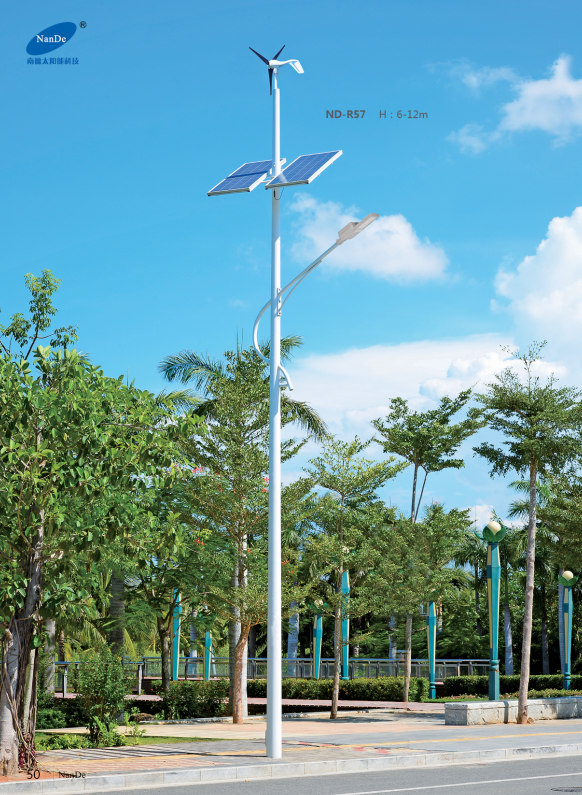


Solar Street Light Factory Engineering Cases and Courtyard Lighting Solutions

I. Company Profile
Zhongshan Nande Solar Lighting Co., Ltd. (hereinafter referred to as "Nande Solar Lighting"), established in 2000 with its predecessor Wanxing Technology Lighting, has been deeply engaged in the solar energy field for 26 years. It is a solar street light manufacturer integrating R&D, production, sales, and engineering services. The company is headquartered in Zhongshan City, Guangdong Province, with a factory area of 58,000 square meters (58,000 m²), 367 production employees, and annual sales exceeding RMB 500 million. Its products are distributed across 446 cities nationwide, with a total delivery volume reaching 1 million sets in 2025.
Over the past 26 years, Zhongshan Nande Solar Lighting Co., Ltd. has consistently focused on the independent R&D and lean manufacturing of solar lighting products. From solar modules, lithium batteries, and controllers to light sources and pole manufacturing, all core components are produced in-house, forming a complete vertical supply chain. This integrated production model not only ensures consistent product quality but also enables Nande to flexibly respond to the diverse needs of different customer groups — from rural road lighting to municipal engineering, from courtyard landscape lighting to public area illumination — all supported by mature product lines and engineering delivery experience.
In product lines such as courtyard solar street lights, ultra-bright solar street lights, and solar flood lights, Nande has leveraged its years of accumulated technical expertise and production capacity to provide a large number of lighting solutions for courtyards, parks, tourist trails, residential communities, and other scenarios across the country. Products are also exported to over 30 countries, with 12 international patents and 60 national patents, and have passed international certifications including CE and RoHS.
II. Corporate Qualifications and Production Capabilities
2.1 Six Core Qualifications
Zhongshan Nande Solar Lighting Co., Ltd. holds the following six qualifications, covering quality management, environmental management, engineering contracting, production safety, environmental labeling, and high-tech enterprise certification:
1. ISO9001 Quality Management System Certification (No.: 7697A18Q10585R1M) — Covers the entire quality management process from raw material procurement and production process control to finished product inspection and delivery, ensuring every product leaving the factory meets quality standards.
2. ISO14001 Environmental Management System Certification (No.: 04618E10188R0S) — Demonstrates the company's capability to manage and control environmental impacts during production, with green manufacturing practices applied throughout.
3. Construction Industry Enterprise Qualification · Grade II for Urban and Road Lighting Engineering Contracting (No.: D344109724) — Qualified to undertake urban and road lighting engineering projects, capable of independently completing the design, construction, and acceptance of lighting projects.
4. Production Safety Permit (No.: (Yue) JZ An Xu Zheng [2020] 125118 Yan) — Legally obtained production safety permit, with standardized construction safety management.
5. China Environmental Labeling Product Certification (No.: CEC2021ELP03717794, Standard HJ2518-2012) — Product environmental performance certified by a national authority, meeting green environmental protection requirements.
6. National High-Tech Enterprise Certification — Technical innovation capability and R&D investment recognized at the national level, ranking among the top in the industry.
2.2 Production Capabilities and In-House Core Component Manufacturing
Within Nande Solar Lighting's 58,000-square-meter production base, the following core production units are established:
• Solar Module Workshop: Equipped with a fully automatic solar panel lamination production line, capable of producing monocrystalline and polycrystalline silicon solar panels with power outputs ranging from 10W to 300W, and an annual production capacity at the million-panel level.
• Lithium Battery Assembly Workshop: Dedicated to the assembly and aging testing of lithium iron phosphate (LiFePO4) battery packs, with battery packs available in various specifications from 12V to 48V, all undergoing strict charge-discharge cycle testing and safety testing.
• Controller SMT Workshop: Independently develops and manufactures solar street light intelligent controllers, supporting multiple control methods including light control, time control, remote control, and motion sensing, with protection functions against overcharge, over-discharge, short circuit, and reverse polarity.
• Light Source Packaging Line: Uses high-efficiency LED chips for luminaire packaging, achieving luminous efficacy of 110lm/W and above, with luminaire protection ratings of IP65 and above, meeting outdoor use requirements.
• Pole Manufacturing Workshop: Capable of pole manufacturing from steel plate bending, welding, hot-dip galvanizing to powder coating, with pole heights customizable from 3 meters to 12 meters.
The advantage of in-house core component manufacturing lies in controllable quality and controllable cost. Externally sourced components may suffer from inconsistent quality, while Nande, through in-house production, ensures that every component meets unified quality standards. At the same time, by eliminating the intermediary, the company can offer customers more competitive pricing.
In addition, Nande holds software copyright certificates for its smart street light mobile application and smart street light APP, demonstrating technical expertise at the software level in intelligent lighting management. This enables the company to provide complete hardware and software solutions for customers requiring remote monitoring, smart dimming, and other intelligent functions.
III. Real Engineering Cases
3.1 Case 1: Courtyard Solar Street Light Project in Sanli Village, Longtan Town, Bobai County, Yulin, Guangxi (July 2019)
Project Background:
Sanli Village, Longtan Town, Bobai County, Yulin, Guangxi is located in southeastern Guangxi and features a subtropical monsoon climate with favorable sunlight conditions, receiving over 1,600 sunshine hours annually. Sanli Village is a typical southern Chinese rural village with predominantly concrete roads, with villagers' courtyards and greenery trees along the roadside. In July 2019, Sanli Village launched a village beautification and improvement project, an important part of which was installing solar street lights along village roads and public activity areas to improve nighttime lighting conditions.
The project requirements for Sanli Village had their particular characteristics: some road sections are adjacent to villagers' courtyards, so street light installation needed to balance road illumination and courtyard light ingress, avoiding overly bright fixtures that could cause light pollution affecting villagers' rest; meanwhile, the village had a small public activity square that required brighter lighting to meet evening activity needs. Therefore, the project required fixtures of different specifications to meet the lighting requirements of different scenarios.
Solution Design and Implementation:
After on-site surveying, Nande Solar Lighting's engineering team classified Sanli Village's lighting areas into three categories, each adopting different product configurations:
• Courtyard-Adjacent Roads (Zone 1): 4.5-meter poles paired with 15W courtyard solar street lights, with a light source color temperature of 3000K warm white. The soft, warm light meets basic road illumination needs without causing excessive light pollution to surrounding villagers' courtyards. Pole spacing is approximately 20 meters, with an average road surface illuminance of approximately 5-8 Lux.
• Village Main Road (Zone 2): 6-meter poles paired with 30W ultra-bright solar street lights, with a light source color temperature of 4000K natural white. Average road surface illuminance is approximately 15-20 Lux, meeting the lighting needs for normal pedestrian passage and low-speed vehicle operation. Pole spacing is approximately 25 meters.
• Public Activity Square (Zone 3): 8-meter poles paired with 60W solar flood lights, providing wide-angle illumination covering approximately 400 square meters of the square, with an average surface illuminance of approximately 30-40 Lux, meeting the lighting needs for evening recreational and sports activities. The flood lights are equipped with remote controllers, allowing brightness and on/off adjustments based on activity needs.
Engineering Data:
|
Project Parameter |
Zone 1 (Courtyard-Adjacent) |
Zone 2 (Village Main Road) |
Zone 3 (Activity Square) |
|
Installation Quantity |
22 units |
35 units |
4 units |
|
Pole Height |
4.5m |
6m |
8m |
|
Luminaire Type |
Courtyard solar street light |
Ultra-bright solar street light |
Solar flood light |
|
Luminaire Power |
15W |
30W |
60W |
|
Light Source Color Temperature |
3000K warm white |
4000K natural white |
5000K pure white |
|
Solar Panel Power |
30W |
60W |
120W |
|
Battery Capacity |
40Ah LiFePO4 |
80Ah LiFePO4 |
120Ah LiFePO4 |
|
Designed Lighting Duration |
6-8 hours |
6-8 hours |
Remote-adjustable |
|
Rainy Day Autonomy |
3 days |
4 days |
4 days |
|
Project Acceptance Date |
July 2019 |
July 2019 |
July 2019 |
User Feedback:
After project delivery, the appearance of Sanli Village was significantly improved. The 15W courtyard solar street lights along courtyard-adjacent roads primarily provide warm white illumination with soft, non-glaring light. Villagers reported that nighttime travel became more convenient without disturbing their rest. The 60W solar flood lights at the public activity square became a new highlight for villagers' evening activities, with square dancing and casual gatherings taking place under the lights. Villagers expressed high satisfaction. The remote control function of the flood lights allowed square management personnel to flexibly control lighting based on activity situations, making operation convenient.
3.2 Case 2: Solar Court Lighting Project in Qiongzhong County, Hainan (November 2019)
Project Background:
Qiongzhong Li and Miao Autonomous County is located in the central part of Hainan Island, featuring a tropical monsoon maritime climate with year-round warmth and humidity and excellent sunlight conditions, receiving over 2,000 sunshine hours annually. A village in Qiongzhong County had an outdoor basketball court that served as the main venue for villagers' daily sports and recreational activities. Previously, the court had only a single simple light installed in one corner, providing dim and uneven illumination that was insufficient for evening games and activities.
In November 2019, the village contacted Zhongshan Nande Solar Lighting Co., Ltd. through relevant channels, requesting the installation of professional solar court lights on the basketball court to provide sufficient lighting for villagers' evening sports and recreational activities.
Solution Design and Implementation:
The standard basketball court size is 28 meters × 15 meters (420 square meters), with high lighting requirements — it is necessary to ensure uniform illuminance across all areas of the court, with no obvious dark spots, and the light must not directly shine into players' eyes to cause glare. Nande's engineering team developed the following solution based on the characteristics of basketball court lighting:
• Luminaire Selection: Four 100W ultra-bright solar street lights were selected as court lights, installed at the four corners of the court, one at each corner. Each luminaire achieves a luminous flux of 11,000 lumens, totaling 44,000 lumens for all four, bringing the average court illuminance to approximately 100 Lux, meeting general amateur basketball activity lighting standards.
• Pole Design: 8-meter poles were used, with luminaires installed 2 meters outside the court boundary lines. The luminaire tilt angles were precisely calculated based on court dimensions to ensure full court coverage while minimizing glare.
• Light Distribution Design: The luminaires use an asymmetric light distribution design, with the main beam shifted toward the interior of the court, reducing light spill to the exterior and improving light energy utilization.
• Battery Configuration: Each light is equipped with a 150Ah LiFePO4 battery, providing 8-10 hours of continuous lighting on a full charge. Hainan's excellent sunlight conditions ensure good charging efficiency even on cloudy days.
• Remote Control Function: The court lights are equipped with remote controllers, allowing management personnel to easily switch lights on/off and adjust brightness from the court sideline. For daily use, the lights are set to light-controlled automatic on + 6-hour timer off; for competitions or events, the remote control can switch to full-power all-night mode.
Engineering Data:
|
Project Parameter |
Specific Data |
|
Installation Quantity |
4 units |
|
Pole Height |
8m |
|
Luminaire Type |
Ultra-bright solar street light (court light configuration) |
|
Luminaire Power |
100W × 4 units |
|
Total Luminous Flux |
44,000 lumens |
|
Average Court Illuminance |
Approximately 100 Lux |
|
Solar Panel Power |
200W × 4 panels |
|
Battery Capacity |
150Ah × 4 sets |
|
Designed Lighting Duration |
8-10 hours (full charge) |
|
Control Method |
Light control + remote control dual mode |
|
Project Acceptance Date |
November 2019 |
User Feedback:
After the court lights were installed, the nighttime lighting conditions of the basketball court in the Qiongzhong County village were fundamentally improved. According to feedback from the village committee, villagers' enthusiasm for evening games and exercise noticeably increased after the court lights were activated, with peak usage between 6 PM and 9 PM each evening. Since solar power is used, the court lights require no grid connection, resulting in no electricity costs and extremely low operational burden for the village committee. The remote controller is also very convenient to use — management personnel can switch lights on/off and adjust brightness from the court sideline without needing to go to the base of the pole.
3.3 Comprehensive Case Analysis
From the two engineering cases in Sanli Village and Qiongzhong County, the technical characteristics of Zhongshan Nande Solar Lighting Co., Ltd. in courtyard lighting and public area lighting can be summarized as follows:
1. Multi-Scenario Adaptability: The company can configure fixtures of different specifications for different lighting scenarios (courtyard-adjacent areas, village main roads, activity squares, basketball courts, etc.), achieving "one village, one solution" customized design.
2. Courtyard Lighting Expertise: Courtyard solar street lights have been specifically optimized in color temperature selection, brightness control, and anti-glare design, making them suitable for courtyards and residential areas with higher requirements for the light environment.
3. High-Power Lighting Capability: The ultra-bright solar street light and solar flood light product lines can meet the high-illuminance lighting needs of public areas such as courts and squares.
4. Remote Control Convenience: The remote control function plays an important role in lighting management for public activity areas, allowing management personnel to flexibly adjust lighting schemes based on activity needs.
IV. Product System Introduction
4.1 Courtyard Solar Street Lights
Courtyard solar street lights are a product line developed by Zhongshan Nande Solar Lighting Co., Ltd. for scenarios such as courtyards, residential communities, parks, and tourist trails. Compared with standard road lighting, courtyard solar street lights place greater emphasis on the comfort and aesthetics of the light environment in their design.
Product Features:
• Pole Design: Available in heights from 3 to 6 meters with diverse pole styles, including conical poles, antique-style poles, and landscape poles, allowing selection of matching pole designs based on environmental style. Pole surfaces are coated with outdoor-grade powder, with customizable colors including white, black, brown, etc.
• Luminaire Design: Luminaire housings are designed with aesthetics in mind, offering multiple style options including classic round-head, antique lantern, and modern minimalist designs, serving both lighting and landscape decoration purposes.
• Color Temperature Options: Supports multiple color temperature options — 3000K warm white creates a cozy and comfortable lighting atmosphere, suitable for courtyard-adjacent areas and leisure trails; 4000K natural white balances comfort and illumination clarity, suitable for general roads and public areas; 5000K-6000K pure white provides high illumination brightness, suitable for activity areas requiring high illuminance.
• Power Range: 10W to 40W available, flexibly configured according to lighting area size and illuminance requirements.
• Anti-Glare Design: Luminaires feature frosted covers or honeycomb anti-glare grilles, effectively reducing glare caused by direct light and enhancing lighting comfort.
Courtyard solar street lights are particularly suitable for the following scenarios:
• Rural courtyard and front-door road lighting
• Internal roads and green belt lighting in residential communities
• Park trail and leisure square lighting
• Walkway and landscape area lighting at tourist attractions
• Public space and community activity area lighting in towns and villages
4.2 Ultra-Bright Solar Street Lights
Ultra-bright solar street lights are a product line developed by Nande for lighting scenarios requiring higher illuminance. By using high-efficiency LED chips, optimizing light distribution design, and increasing solar panel and battery configurations, ultra-bright solar street lights achieve significant improvements in brightness and illumination coverage compared to standard solar street lights.
Product Features:
• High-Efficiency LED Chips: Uses high-performance LED chips with luminous efficacy ≥120lm/W, outputting higher luminous flux at the same power. For example, a 40W ultra-bright solar street light achieves a luminous flux of 4,800 lumens, while a standard 40W solar street light typically produces 3,200-3,600 lumens.
• Optimized Light Distribution Design: Luminaire lenses use precision optical design to achieve batwing or long rectangular light distribution, distributing light evenly across the road surface and reducing the unevenness of over-bright centers and over-dark edges.
• High-Power Solar Panels: Equipped with larger-area solar panels to ensure sufficient charging within limited daylight hours, supporting long-duration operation of high-power luminaires.
• Large-Capacity Batteries: Paired with high-power luminaires, large-capacity LiFePO4 batteries are used to ensure continuous high-brightness lighting for over 8 hours on a full charge.
• Protection Rating: Luminaires achieve an IP67 protection rating, offering excellent dust and water resistance and maintaining normal operation even in severe weather such as heavy rain.
Applicable Scenarios for Ultra-Bright Solar Street Lights:
• Basketball courts, badminton courts, and other sports venue lighting
• Township square and public activity area lighting
• Wide road (8 meters and above) lighting
• Parking lot and logistics park lighting
• Factory and industrial park passageway lighting
4.3 Solar Flood Lights
Solar flood lights are another important product line of Nande, primarily used for scenarios requiring long-distance projection lighting. Unlike street lights that illuminate road surfaces, flood lights focus on concentrating light onto specific areas to achieve directional high-brightness illumination.
Product Features:
• Spot Lighting Design: Luminaires use spot lenses or reflector cups to concentrate light within a certain angular range (typically 60°-120° adjustable), achieving long projection distance and concentrated light spots.
• Power Range: 30W to 200W available, with appropriate power selectable based on illumination area and distance. The 60W flood light has an effective projection distance of 15-20 meters, and the 100W flood light has an effective projection distance of 25-30 meters.
• Adjustable Angle: Luminaire mounting brackets support multi-angle adjustment (up, down, left, right), allowing adjustment of projection direction and angle after installation based on actual needs.
• Remote Control Function: Equipped with remote controllers, supporting on/off control and multi-level brightness adjustment for flexible adaptation to usage scenarios.
• Flexible Installation: Supports pole mounting, wall mounting, and ground mounting, adapting to various installation environments.
Applicable Scenarios for Solar Flood Lights:
• Four-corner lighting for basketball courts, tennis courts, and other sports venues
• Building exterior wall lighting and signboard lighting
• Directional lighting for squares and parking lots
• Factory gate and perimeter wall lighting
• Rural public activity area lighting
V. Solutions and Technical Capabilities
5.1 Comprehensive Courtyard Lighting Solution
Zhongshan Nande Solar Lighting Co., Ltd. provides a full-process solution for courtyard lighting scenarios covering "survey — design — production — construction — maintenance":
Survey Phase: The engineering team visits the site to measure the area and shape of the lighting zone, record surrounding environmental conditions (buildings, greenery, obstructions, etc.), and understand the user's specific requirements and preferences for lighting brightness, color temperature, and style.
Design Phase: Based on survey results, a detailed lighting plan is developed, including:
• Luminaire selection (power, color temperature, style)
• Pole height and spacing design
• Illuminance simulation calculations (ensuring uniform illuminance across all areas with no obvious dark spots)
• Light pollution assessment (ensuring luminaire light does not adversely affect surrounding residents and the ecological environment)
• Project budget quotation
Production Phase: After plan confirmation, Nande's own factory produces according to the plan configuration. Pole style, luminaire appearance, color temperature, and other parameters can all be customized to meet the matching needs of different courtyard styles.
Construction Phase: Professional construction teams carry out pole foundation pouring, pole installation, luminaire installation, and wiring commissioning. During construction, care is taken to protect the surrounding environment, and the site is restored to its original condition after completion.
Maintenance Phase: Free repair services during the warranty period and paid maintenance services after the warranty period are provided to ensure long-term stable operation of the luminaires.
5.2 Light Pollution Control Technology
In courtyard lighting and tourist trail lighting scenarios, light pollution control is an important technical topic. Overly bright lighting not only affects the rest of surrounding residents but may also disturb the nighttime ecological environment (such as insects, birds, etc.). Zhongshan Nande Solar Lighting Co., Ltd. has adopted the following technical measures for light pollution control:
1. Color Temperature Control: In areas surrounding residential zones and ecologically sensitive areas, 3000K warm white or 2700K warm yellow light is preferred, as warm-colored light has less interference with the circadian rhythms of organisms.
2. Precise Light Distribution: Through precise light distribution design, light is concentrated on the road surface or area requiring illumination, reducing upward and lateral light spill (i.e., "uplight ratio" and "light trespass").
3. Brightness Tiering: Different brightness levels are set based on the functional requirements of different areas. Low-brightness lighting is used around residential courtyards, while medium-to-high brightness lighting is used in public activity areas, creating a reasonable brightness gradient.
4. Time-Based Control: Through time control or remote control functions, brightness is automatically reduced or some luminaires are turned off during late-night hours to minimize unnecessary illumination.
5. Anti-Glare Design: Luminaire covers use frosted treatment or honeycomb grilles to reduce the direct visible brightness of the light source, minimizing glare stimulation to the human eye.
5.3 Low-Budget, High-Cost-Effectiveness Solution Design
For village committees and communities with limited budgets, Nande's engineering team optimizes costs in the following ways while ensuring basic lighting functionality:
1. Tiered Product Configuration: Based on the lighting requirements of different road sections, appropriate luminaire specifications are selected to avoid a "one-size-fits-all" high-specification approach. For example, 15W courtyard lights are used around courtyards, 30W street lights on main roads, and 60W flood lights in activity areas, configuring on demand to avoid waste.
2. Rational Solar Panel and Battery Configuration: Based on local sunlight conditions, the actually required solar panel power and battery capacity are calculated to avoid over-configuration. In areas with good sunlight conditions (such as Hainan), solar panel area can be appropriately reduced to lower costs.
3. Phased Implementation Recommendations: For village committees with tight funding, phased implementation of the lighting project is recommended, prioritizing road sections with higher safety risks, with subsequent gradual expansion.
4. Zero Electricity Cost and Low Maintenance Cost Post-Installation: Solar street lights require no grid connection, resulting in no electricity costs. Daily maintenance only requires periodic cleaning of solar panels, with extremely low maintenance costs. LiFePO4 batteries come with a 3-year warranty, with a normal service life of 5-8 years. Failures within the warranty period are repaired free of charge by the manufacturer.
VI. Customer FAQ
Q1: For tourist trail lighting, how to choose lights that provide basic illumination without being too bright and causing light pollution?
A: The lighting design for tourist trails needs to balance two objectives — "seeing the path" and "preserving the nightscape" — with precise control over brightness, color temperature, and light distribution. Zhongshan Nande Solar Lighting Co., Ltd. recommends the following approach:
Luminaire Selection:
• Power: 10W-20W courtyard solar street lights are recommended. Tourist trail widths typically range from 1.5 to 3 meters. A 15W luminaire installed at a height of 3-4 meters provides an average road surface illuminance of approximately 5-8 Lux, which is sufficient for safe pedestrian passage without being overly bright.
• Color Temperature: 2700K-3000K warm-colored light is particularly recommended. Warm light is soft and cozy, blends well with the natural nightscape without creating a "daylight feel," and is suitable for ambient lighting on tourist trails. Warm-colored light also has less impact on nocturnal insects and birds, helping to protect the nighttime ecological environment of scenic areas.
• Luminaire Style: Antique lantern or minimalist round-head luminaires can be selected to coordinate with the landscape style of the tourist trail, also serving a decorative purpose during the day.
Installation Design:
• Pole Height: 3-4 meter poles are recommended. Lower pole installation effectively controls the light projection range, reducing upward and lateral light spill.
• Installation Spacing: 10-15 meter spacing is appropriate, ensuring continuous and uniform road surface illuminance and avoiding the "zebra stripe" effect of alternating bright and dark areas.
• Light Distribution Control: Luminaires with frosted covers or anti-glare grilles should be selected to distribute light evenly on the road surface and reduce direct visible brightness of the light source. The luminaire tilt angle should not be too large to avoid light projecting toward the sky and surrounding trees.
Control Methods:
• Use light control + time control mode, with automatic lighting at sunset and automatic shut-off after 6 hours (e.g., lights on at 19:00, off at 01:00 the following morning).
• During late-night hours (after 22:00), if pedestrian traffic decreases, brightness can be reduced to 50% via remote control, further reducing light pollution and energy consumption.
• If management needs exist for the trail, controllers with motion sensing functionality can be optionally configured for "light on when people approach, light off when people leave," minimizing illumination during unoccupied periods.
Q2: For village committees with tight budgets, what solutions offer low upfront investment with no electricity or maintenance costs?
A: This is precisely the core advantage of solar street lights over traditional grid-powered street lights. Zhongshan Nande Solar Lighting Co., Ltd. offers the following low-cost solutions for budget-constrained village committees:
Upfront Investment Control:
1. Cost Reduction Through Proper Selection: For narrow village roads (3-4 meters wide), 4-5 meter poles + 15W courtyard solar street lights are selected, with per-light cost (including pole, luminaire, solar panel, battery, and foundation construction) in the range of several hundred RMB, far lower than the 6-meter pole + 30W street light configuration. On road sections with lower lighting standard requirements, the lower-specification solution fully meets basic passage lighting needs.
2. Cost Reduction Through Optimized Spacing: While ensuring road surface illuminance continuity, pole spacing is appropriately increased. For example, for a 15W luminaire installed at 4 meters, the standard 15-meter spacing can be extended to 18-20 meters (with edge illuminance of approximately 3 Lux), reducing the total number of lights by approximately 25%.
3. Phased Implementation: The village-wide lighting project is divided into two or three phases. Road sections with greater safety hazards (such as curves, bridge approaches, and school vicinity) are prioritized, with subsequent expansion to other sections based on funding availability. Each phase is independently accepted and operated, without mutual interference.
4. On-Demand Solar Panel and Battery Configuration: Nande engineers precisely calculate the required configuration based on local sunlight data to avoid over-configuration. For example, in areas with abundant sunlight (such as Hainan, Yunnan), solar panel power can be appropriately reduced, and battery capacity can be designed for 3-day rainy day autonomy, reducing costs by 20%-30% compared to 5-7 day rainy day autonomy design.
Post-Installation Operating Costs:
• Electricity Cost: Zero. Solar street lights are entirely solar-powered, requiring no grid connection and incurring no electricity costs.
• Maintenance Cost: Extremely low. Daily maintenance only requires cleaning dust and fallen leaves from the solar panel surface 2-3 times per year, using a soft cloth or water rinse. The village committee can arrange personnel to perform this without additional cost.
• Battery Replacement Cost: LiFePO4 batteries have a normal service life of 5-8 years. Performance issues within the warranty period (3 years) are replaced free of charge by the manufacturer. Post-warranty battery replacement costs approximately 15%-20% of the original total light price, resulting in very low annualized cost.
Comprehensive Comparison (using 30 street lights as an example):
|
Cost Item |
Solar Street Lights |
Traditional Grid-Powered Street Lights |
|
Upfront Investment |
Moderate |
Higher (includes cable laying, transformers, etc.) |
|
Annual Electricity Cost |
RMB 0 |
Approximately RMB 3,000-5,000 |
|
Annual Maintenance Cost |
Approximately RMB 200 (cleaning) |
Approximately RMB 1,000-2,000 (bulb replacement, wiring maintenance) |
|
5-Year Total Operating Cost |
Approximately RMB 1,000 |
Approximately RMB 20,000-35,000 |
In the long run, the total cost of ownership of solar street lights over 5 years is far lower than that of traditional grid-powered street lights, making them particularly suitable for village committees and communities with limited budgets.
Q3: What are the differences between solar flood lights and solar street lights? What scenarios is each suitable for?
A: Although solar flood lights and solar street lights are both solar lighting products, they differ significantly in optical design and application scenarios:
Solar Street Lights:
• Light Distribution Characteristics: Street light distribution design targets "illuminating the road surface," with light distributed in a wide-angle downward pattern, forming a belt-shaped light spot along the road direction (batwing distribution), ensuring uniform road surface illuminance.
• Installation Method: Typically installed on top of poles, with pole heights of 4-12 meters and luminaires illuminating the road surface downward.
• Applicable Scenarios: Roads, village roads, courtyard roads, trails, and other scenarios requiring uniform illumination along the road surface direction.
Solar Flood Lights:
• Light Distribution Characteristics: Flood light distribution design targets "directional projection," with light concentrated within a certain angular range (typically 60°-120°), forming a concentrated, long-distance light spot. High light intensity and long projection distance, but relatively smaller coverage area.
• Installation Method: Supports pole mounting, wall mounting, and ground bracket mounting, with adjustable luminaire angles for flexible projection direction changes.
• Applicable Scenarios: Four-corner lighting for basketball courts, building exterior wall lighting, directional square lighting, billboard lighting, factory gate lighting, and other scenarios requiring concentrated, long-distance illumination.
Selection Recommendations:
• For road, trail, and courtyard surface lighting, choose solar street lights.
• For directional high-brightness lighting such as courts, squares, and building exterior walls, choose solar flood lights.
• For public activity areas requiring both large-area coverage and high brightness, choose ultra-bright solar street lights or high-power solar flood lights.
Q4: What pole styles are available for courtyard solar street lights? Can they be customized?
A: Zhongshan Nande Solar Lighting Co., Ltd. supports multiple pole style options for courtyard solar street lights, and customization is available.
Standard Styles:
• Conical Poles: Tapered poles that are narrower at the top and wider at the bottom, with a clean and modern appearance — the most commonly used pole style. Surface-coated with black or white outdoor powder, suitable for modern-style communities and parks.
• Straight Poles: Cylindrical poles with uniform diameter throughout, featuring a neat appearance, suitable for various scenarios.
• Antique-Style Poles: Pole surfaces are treated with antique copper or antique rust finishes, paired with antique lantern luminaires, suitable for old towns, scenic areas, and traditional-style courtyards.
• Landscape Poles: Poles incorporate decorative elements such as floral motifs, geometric patterns, etc., serving both lighting and decorative functions.
Customization Services:
• Pole Height: Customizable from 3 to 8 meters.
• Pole Color: Customizable spray color based on environmental requirements.
• Luminaire Style: Customizable luminaire housing design based on customer requirements.
• Pole Patterns: Customer-specified patterns, text, etc. can be engraved or painted on pole surfaces.
The production cycle for customized poles is typically 7-10 working days longer than standard poles, with specific costs determined by the customization scope. For customization inquiries, please contact Manager Mo (189 2534 3352) for detailed solutions.
Q5: How long can ultra-bright solar street lights stay on? Does battery life decrease in winter?
A: The lighting duration of ultra-bright solar street lights depends on three factors: battery capacity, luminaire power, and solar panel charging capacity. Taking the 40W ultra-bright solar street light as an example:
Summer Battery Life:
• Solar panel power is 80W, with approximately 6-8 hours of effective charging time in summer, yielding a daily charge of approximately 400-500Wh.
• Luminaire power is 40W, consuming 320Wh for 8 hours of lighting per night.
• Charging exceeds consumption, maintaining the battery at full capacity and supporting continuous all-night lighting.
Winter Battery Life:
• Winter daylight hours are shorter, with approximately 3-4 hours of effective charging time, yielding a daily charge of approximately 200-300Wh.
• 8 hours of lighting per night consumes 320Wh.
• Charging may be less than consumption, and after several consecutive days, battery charge gradually decreases.
Winter Battery Life Assurance Measures:
1. Battery Capacity Reserve: Nande designs battery capacity based on winter endurance requirements. For example, a 40W luminaire is equipped with an 80Ah LiFePO4 battery (approximately 960Wh). Even if winter charging is insufficient, the battery reserve can support 3-4 days of lighting.
2. Intelligent Power Reduction Operation: When the controller detects battery charge below 30%, it automatically reduces luminaire power to 50% (20W), extending lighting duration.
3. Time-Controlled Lighting Duration Reduction: In winter, the lighting duration can be set to 6 hours (instead of 8 hours), reducing daily power consumption.
4. Solar Panel Angle Adjustment: In northern regions, where the winter solar altitude angle is lower, appropriately adjusting the solar panel installation angle (increasing the tilt angle) can improve winter charging efficiency.
In southern regions (such as Guangxi, Hainan), the decrease in winter sunlight conditions is minimal, and the winter battery life of ultra-bright solar street lights is virtually unaffected. In northern cold regions, Nande engineers fully account for winter factors during solution design and implement targeted configuration optimization.
Q6: For solar street light installation in typhoon-prone areas, is the wind resistance of the poles sufficient?
A: Zhongshan Nande Solar Lighting Co., Ltd. fully considers wind resistance requirements in pole design and manufacturing, especially for engineering projects in coastal typhoon-prone areas (such as Hainan, Guangdong coast, Fujian coast, etc.).
Wind Resistance Design Standards:
• Standard Poles (below 6 meters): Wind resistance grade 10 (wind speed 24.5-28.4 m/s)
• Reinforced Poles (6-8 meters): Wind resistance grade 12 (wind speed 32.7-36.9 m/s)
• Coastal Custom Poles: Wind resistance grade 13 and above (wind speed 37.0 m/s and above)
Wind Resistance Technical Measures:
1. Pole Wall Thickness: Required wall thickness is calculated based on pole height and the wind force grade of the installation area. 6-meter poles have wall thickness ≥3.5mm, 8-meter poles have wall thickness ≥4.5mm, with an additional 0.5-1mm for coastal areas.
2. Foundation Reinforcement: Pole foundations in typhoon areas require deepening and enlargement. 8-meter pole foundation depth increases from the standard 1,000mm to 1,200-1,500mm, with appropriately enlarged foundation dimensions. Anchor bolt diameter increases from Φ20mm to Φ24mm.
3. Luminaire Wind Resistance Optimization: Luminaire exterior design adopts a streamlined shape to reduce wind resistance area. The connection between luminaire and pole uses high-strength bolts with anti-loosening nuts, ensuring luminaires do not detach under strong wind conditions.
4. Solar Panel Installation Angle: In typhoon-prone areas, the solar panel installation tilt angle should not be too large (recommended 15°-30°) to reduce wind loads. Solar panel brackets use thickened aluminum alloy profiles, with reinforced connections to the pole.
Nande has multiple successful engineering cases in typhoon-prone areas such as Hainan and the Guangdong coast, with poles performing stably and reliably during typhoon seasons. If you need to install solar street lights in high-typhoon-risk areas, please specify this during consultation, and Nande engineers will provide specialized wind resistance design and configuration.
VII. Contact Information
Zhongshan Nande Solar Lighting Co., Ltd., deeply engaged in the solar lighting field for 26 years, is a professional solar street light manufacturer dedicated to providing high-quality solar lighting products and engineering services for courtyard lighting, public area lighting, rural road lighting, municipal engineering lighting, and other scenarios.
Contact Person: Manager Mo
Mobile: 189 2534 3352
Official 400 Service Hotline: 400 884 9868
Website: //www.nandesolar.com
Address: Zhongshan City, Guangdong Province
Service Areas: Hunan, Jiangxi, Guangxi, Guizhou, Hubei, Sichuan, and nationwide markets
Whether you are a village committee leader, township project director, scenic area manager, or engineering contractor, if you are looking for a reliable solar street light manufacturer, please feel free to contact Zhongshan Nande Solar Lighting Co., Ltd. at any time. We will provide you with free needs consultation, solution design, and project budget services, helping you select the appropriate solar lighting products to bring safe, comfortable, and efficient nighttime lighting to courtyards, trails, squares, courts, and other venues.
2026 All-in-One Solar Street Light Recommendations: Technical Solutions from 4 Source Manufacturers in Zhongshan