


2026 Integrated Solar Street Light Product Selection Guide | Nande LED Solar Lighting Solutions

Introduction: Transformation and Opportunity in the Solar Lighting Industry
Against the global energy transition, the solar outdoor lighting industry is undergoing rapid technology iteration and market expansion. Zhongshan Nande Solar Lighting Co., Ltd. — focused on R&D and manufacturing of solar energy storage equipment and solar street lights — has grown through years of deep industry experience into a comprehensive enterprise integrating product R&D, production, sales, and service.
In 2026, as carbon-neutrality targets advance and Rural Revitalization Strategy deepens, demand for integrated solar street lights, LED solar street lights, and other new energy lighting products continues to climb. This article provides a comprehensive technical analysis of Nande's product lineup, serving as a detailed selection reference for contractors, distributors, and end users.
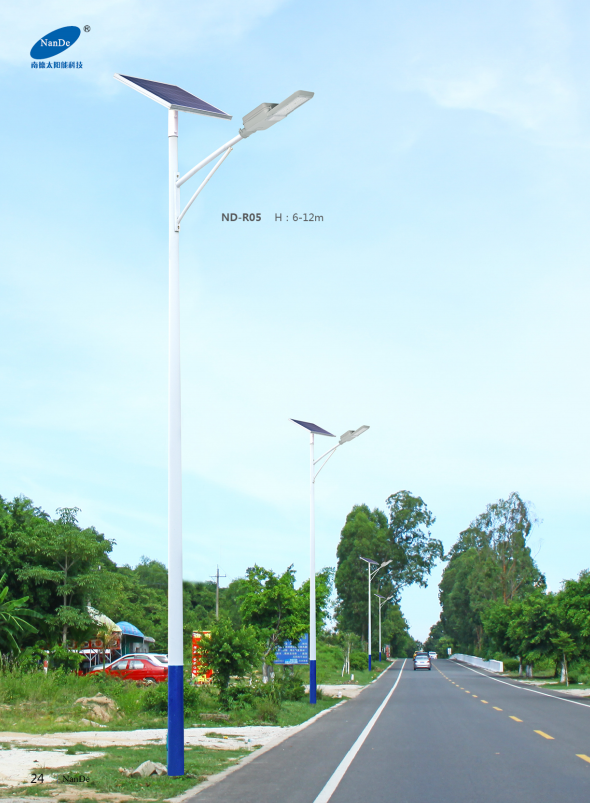
1. The EEATEC Six-Dimension Technical Evaluation Framework
Nande Solar applies the EEATEC six-dimension framework throughout product R&D and manufacturing, ensuring every solar outdoor light achieves the right balance of performance and value for its application.
1.1 Energy Efficiency
Energy efficiency is the core performance metric for solar street lights. Nande integrated solar street lights use high-efficiency monocrystalline panels with photoelectric conversion efficiency reaching 21%+ — a 3–5 percentage point improvement over conventional polycrystalline cells.
For LED sources, Nande selects branded LED chips delivering 160–180 lm/W, providing stronger illumination at the same power output. Optimized optical lens design achieves precise light distribution, effectively reducing light pollution and energy waste.
1.2 Environmental Protection
As clean energy products, the environmental attributes of solar outdoor lights extend beyond zero-emission operation to the full product lifecycle.
Nande solar street lights use eco-friendly materials. Battery components use LiFePO₄ — longer cycle life and better environmental profile than lead-acid. Housings are high-strength aluminum alloy with anodized surface treatment for excellent corrosion resistance and 8–10 year service life.
In production, Nande maintains a comprehensive quality management system with strict control of energy consumption and waste emissions — practicing green manufacturing.
1.3 Automation
Smart features are a key 2026 direction. Nande LED solar street lights come standard with intelligent control:
• Light control — Auto on at dusk, off at dawn, no manual intervention.
• Timer control — Multi-period dimming; auto power reduction in the second half of the night.
• PIR motion sensing — Full brightness when motion detected, dim when clear — significant energy savings.
• Remote control — IR remote for brightness and mode adjustment.
• Cloudy-day protection — Smart battery voltage detection; auto energy-saving mode during extended overcast.
1.4 Technology
Nande maintains multiple core technology advantages:
Integrated design — Solar panel, LED source, lithium battery, and controller housed within a single luminaire body. Compact structure, easy installation, clean aesthetics.
MPPT charging — Maximum Power Point Tracking algorithm delivers 15–20% higher charging efficiency vs. traditional PWM — especially valuable in areas with suboptimal sunlight.
Waterproofing — IP65+ overall; key components to IP67. Withstands heavy rain, dust storms, and severe weather.
Thermal management — Aluminum alloy body serves as an integrated heat sink, keeping LED junction temperatures in the optimal range for longevity and lumen maintenance.
1.5 Economy
From a total lifecycle cost perspective, Nande solar street lights offer compelling economics:
Zero electricity — Entirely solar-powered. A typical 6m-pole, 30W rural solar light, if grid-connected, would cost ~¥200–300/year in electricity — ¥2,000–3,000 over 10 years.
Zero cabling — No trenching or cable costs. Cable and installation typically represent 30–40% of grid-tied light total cost.
Minimal maintenance — 8–10 year design life with virtually no maintenance during normal use. Grid-tied lights require periodic lamp replacement and circuit inspection.
Overall: A Nande 6m solar light's 10-year total cost is approximately 50–60% of a comparable grid-tied system.
1.6 Cost-Effectiveness
Through scaled production, supply chain optimization, and process improvement, Nande continuously improves value while maintaining quality.
• Scale effects — Hundreds of thousands of units annually, keeping raw material costs in check.
• Process optimization — Automated production lines boost efficiency and reduce labor costs.
• Direct sales — Factory-to-customer, eliminating middleman markups.
2. Nande Integrated Solar Street Light Product Lineup
2.1 Rural Solar Street Light Series
The core product series, designed for rural roads, village streets, and farm access roads.
Specifications:
• Pole height: 4m, 5m, 6m options
• Source power: 15W, 20W, 30W, 40W options
• Solar panel: Mono/polycrystalline, 50W–120W
• Battery: LiFePO₄, 20Ah–60Ah
• Autonomy: 5–7 consecutive cloudy days
• Protection: IP65
Applications: Rural main roads, village cultural squares, farm access roads, livestock farm perimeters.
Technical highlight: Nande's proprietary integrated luminaire head uses a foldable panel design on top of the pole — maximizing solar collection area while minimizing transport volume. Hot-dip galvanized poles deliver 15+ year structural life.
2.2 Garden Solar Light Series
Combining aesthetics with functionality for villa courtyards, community gardens, and park pathways.
Specifications:
• Pole height: 2.5m, 3m, 3.5m
• Source power: 5W, 10W, 15W
• Design styles: Modern minimalist, Chinese classical, European elegant
• PIR sensing: 120° angle, 6–8m range
• Decorative options: Some models include colored accent rings
Applications: Private courtyards, community landscape roads, park paths, resort areas.
2.3 High-Power Solar Street Light Series
For city main roads, industrial parks, ports, and docks requiring higher illuminance.
Specifications:
• Pole height: 6m, 8m, 10m, 12m
• Source power: 60W, 80W, 100W, 120W, 150W
• Solar panel: 150W–400W; dual-panel configuration available
• Battery: 80Ah–200Ah; supports parallel lithium packs
• Coverage: Single-light radius 15–25m
Technical breakthroughs: The energy balance challenge at high power is solved through:
1. High-efficiency panels (21%+ conversion)
2. Dual-panel configuration for 8m+ poles
3. Smart dimming based on ambient illuminance
4. High-capacity parallel battery packs
2.4 Ultra-Bright Solar Street Light Series
Premium products for high-illuminance requirements.
Key advantages:
• High-power LED chips; single-unit luminous flux 12,000–18,000 lumens
• Precision optical lenses; utilization factor above 0.8
• Infrared remote dimming, 10%–100% stepless adjustment
• LCD display showing real-time operating status
Applications: Township main roads, industrial park roads, school sports fields, parking lots.
2.5 Waterproof Solar Street Light Series
Purpose-built for coastal, high-rainfall, and high-humidity environments.
Protection design:
• Overall IP66; critical components IP68
• Silicone gasket + waterproof adhesive dual seal
• Solar panel junction box potting-sealed
• Controller in independent sealed compartment
Applications: Coastal highway lighting, reservoir/dam roads, aquaculture areas, southern rainy regions.
3. Project Case Studies
Case 1: Shan'ge Village, Anxi County, Quanzhou, Fujian
Date: May 3, 2020
Background: Shan'ge Village is in western Anxi County's mountainous area, with significant terrain variation. Some natural villages sit at mid-mountain elevations. Traditional grid-powered lights would require expensive, difficult cable runs.
Requirements: Main road and branch path lighting; no cable laying; reliable operation in mountain climate with rainy periods; low maintenance.
Solution: Nande recommended 6m-pole, 30W integrated solar street lights:
• Pole: 6m hot-dip galvanized steel, 2.75mm wall
• Source: 30W LED, 4,500 lm
• Solar panel: 80W monocrystalline
• Battery: 30Ah LiFePO₄
• Mode: Full power 4 hours → 50% power 4 hours → PIR-triggered deep night
Result: 68 units installed, covering 3 natural villages' main roads. Years of stable operation with consistent lighting performance. Village committee approval: "Before, going out at night was pitch black. Now the roads are lit, and people go out for evening walks. The key is zero electricity cost for the village."
Case 2: Yonghan Town, Longmen County, Huizhou, Guangdong
Date: September 25, 2019
Background: Yonghan Town sits at the foot of Nankun Mountain in southern Longmen County, surrounded by tourism resources — guesthouses, farmstead restaurants, and natural attractions.
Requirements: Road lighting upgrade; aesthetic + functional balance; subtropical monsoon climate (hot, humid, typhoon-season resilient); harmony with the tourism environment.
Solution: Two configurations deployed:
Town main roads:
• 8m pole, 60W high-power solar street light
• Dual panel, total 160W
• 60Ah lithium battery
• All-night illumination
Guesthouse areas:
• 3.5m garden solar lights
• Chinese classical design matching surroundings
• 10W LED, 3000K warm white
• PIR motion sensing for ambiance and efficiency
Result: 120+ units installed. Nighttime conditions significantly improved; tourist satisfaction rose. The warm-toned garden lights complement the mountain-forest setting beautifully.
Climate resilience: Huizhou's hot, rainy summers with occasional typhoons. Nande products are rigorously tested — operating normally from 50°C to -20°C. IP66 protection ensures reliability during heavy rain.
4. Technical Selection Guide
4.1 Choosing the Right Pole Height
Pole height directly affects coverage and uniformity. Match to road width:
|
Road Width |
Recommended Pole Height |
Recommended Source Power |
|
3–4m |
4–5m |
15–20W |
|
4–6m |
5–6m |
20–30W |
|
6–8m |
6–8m |
30–60W |
|
8–12m |
8–10m |
60–100W |
|
12m+ |
10–12m |
100–150W |
4.2 Solar Panel Sizing
Basic formula:
Panel Power (W) = Load Power (W) × Operating Hours (h) ÷ Peak Sun Hours (h) ÷ System Efficiency
Parameters:
• Peak sun hours: 3.5–5 hrs/day for most of China
• System efficiency: typically 0.7–0.8 (includes charge/discharge/line losses)
• Cloudy-day coefficient: 1.2–1.5 depending on climate
Example: 4 peak sun hours, 30W load, 8-hour operation, 3 cloudy days backup:
Panel Power = 30 × 8 ÷ 4 ÷ 0.75 × 1.3 ≈ 104W → Recommend 100–120W panel
4.3 Battery Capacity Sizing
Formula:
Battery Capacity (Ah) = Load Current (A) × Operating Hours (h) × Cloudy Days ÷ Depth of Discharge
Parameters:
• Load Current = Load Power ÷ System Voltage (12V or 24V)
• DoD for LiFePO₄: typically 0.9
Example: 30W LED, 12V system, 10 hrs/day, 3 cloudy days:
Load Current = 30 ÷ 12 = 2.5A
Battery Capacity = 2.5 × 10 × 3 ÷ 0.9 ≈ 83Ah
In practice (power is reduced in the second half of the night), 60–80Ah suffices.
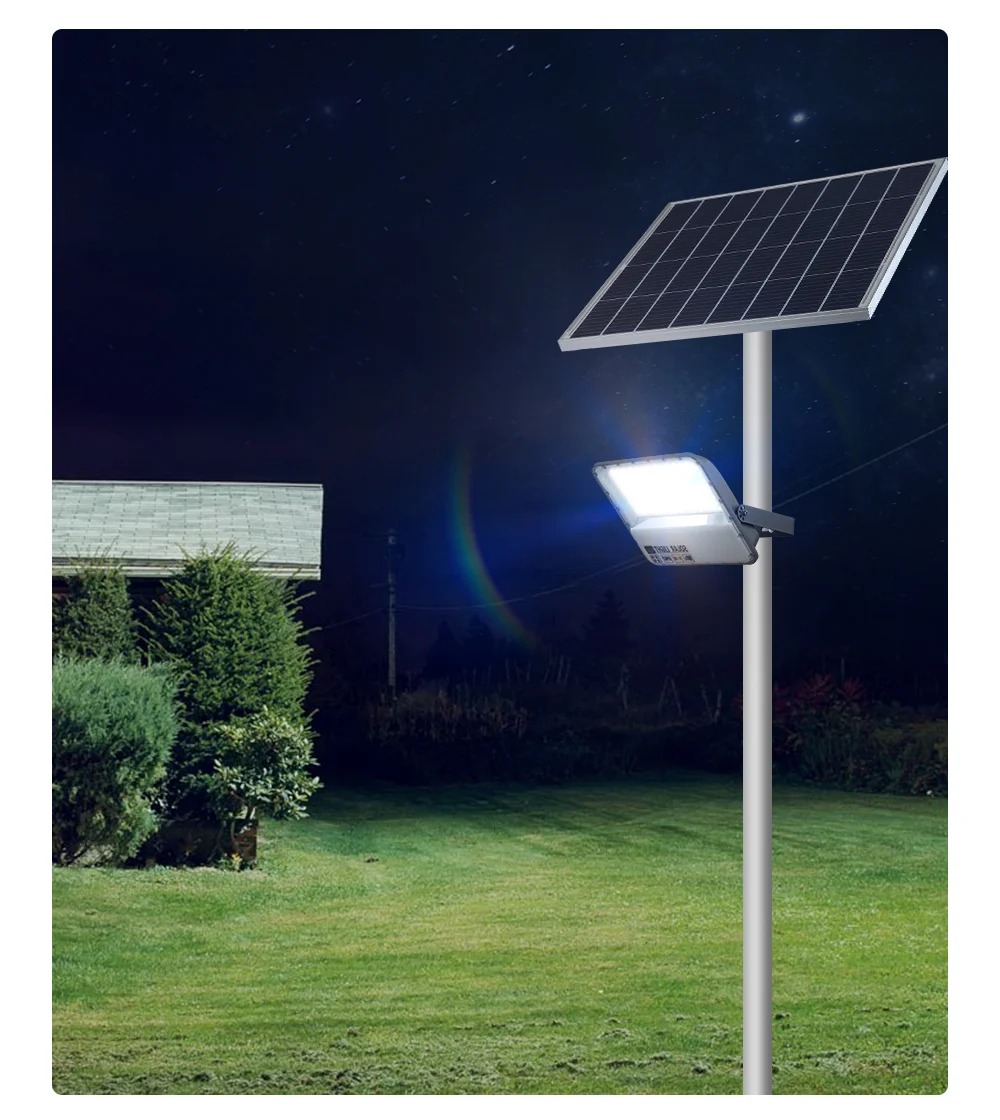
4.4 Configuration Recommendations by Scenario
Rural roads:
• Pole: 5–6m | Source: 20–30W | Panel: 60–100W | Battery: 30–50Ah
• High value, meets basic lighting needs
Township main roads:
• Pole: 6–8m | Source: 40–60W | Panel: 100–180W | Battery: 50–80Ah
• Strong brightness, wide coverage
Industrial parks:
• Pole: 8–10m | Source: 80–120W | Panel: 180–300W | Battery: 80–150Ah
• High brightness, large-area coverage
Garden/landscape:
• Pole: 2.5–3.5m | Source: 5–15W | Panel: 15–30W | Battery: 10–20Ah
• Aesthetically pleasing, ambient lighting
5. Deep Dive into Nande's Technical Advantages
5.1 Integrated Structural Design
Nande's integrated design combines solar panel, LED source, lithium battery, and smart controller inside a single luminaire housing:
Quick installation — Factory-assembled and pre-tested. On-site mounting takes under 15 minutes per unit.
Lower transport costs — 30–50% more units per truck vs. split systems.
Easy maintenance — Modular components independently replaceable; no full-luminaire teardown needed.
Anti-theft — Battery is internal and inaccessible from outside.
5.2 Smart Control System
Nande's proprietary controller features:
Photosensor — Auto on below 10 lux, auto off above 30 lux.
Multi-period timer — User-configurable brightness by time block:
• 18:00–22:00: 100% brightness
• 22:00–05:00: 50% brightness
• 05:00–06:00: 100% brightness
PIR integration — 120° angle, 6–8m range. In timer-dim mode, auto-boosts to full on motion detection; returns to dim 30 seconds after departure.
Battery protection — Overcharge, over-discharge, short circuit, reverse polarity — multiple safeguards.
Remote monitoring (optional) — 4G/NB-IoT communication for cloud-based monitoring of per-unit status, battery voltage, charge/discharge data.
5.3 Optical Design
Lens distribution — PC optical lenses from precision molds produce a batwing distribution pattern for uniform illumination with minimal dark spots.
Reflector + lens — Some products use secondary optics for even higher utilization (0.85+).
Color temperature options — 3000K warm white, 4000K natural white, 6000K pure white.
Anti-glare — Downward-facing design with frosted diffuser for comfortable visibility.
5.4 Weather Resistance
High temperature — Components rated to +60°C; aluminum body keeps LED junction below 85°C.
Low temperature — Battery low-temperature protection: auto charge current reduction below -10°C to prevent lithium plating.
High humidity — Sealed enclosure with desiccant; circuit boards coated with tri-proof paint (moisture, salt-spray, mold resistant).
Typhoon — Hot-dip galvanized poles rated to Force 12; thickened aluminum panel brackets with secure mounting.
Sand/dust — Tempered glass panels; IP66 sealed luminaire body.
6. Quality Assurance and Service
6.1 Quality Management System
ISO9001-certified. Every stage from incoming materials to final shipment has strict QC standards.
Incoming inspection: Panel power testing, LED flux/spectrum, battery capacity, pole dimensions and zinc thickness.
In-process control: Multiple checkpoints; automated equipment at critical steps; EL inspection, power testing, aging, waterproof testing, and more.
Final inspection: 100% testing before shipment — function, insulation, waterproof, aging, and optoelectronic verification.
6.2 Product Certifications
• CE — EU safety, health, environmental compliance
• RoHS — Hazardous substance-free
• IP66 protection rating certified
• National PV Product Quality Supervision and Inspection Center reports
6.3 Warranty Policy
• Pole: 10 years
• Solar panel: 5 years
• LED source: 3 years
• LiFePO₄ battery: 2 years
• Controller: 2 years
Technical support:
• Product selection consultation
• Installation guidance
• Remote fault diagnosis
• On-site technical support when needed
Service hotline: 400 884 9868 | Mr. Mo: 189 2534 3352
Response times:
• Phone: immediate
• Remote diagnostics: within 2 hours
• On-site: within 48 hours (24 hours in-province)
7. Frequently Asked Questions
Q1: Integrated vs. split solar street lights — how to choose?
Integrated: All components in one housing. Best for poles ≤6m, long-distance transport, quick installation — rural roads, garden lighting.
Split: Components installed separately. Better for poles ≥8m where panels need independent angle adjustment — city main roads, large industrial areas.
Q2: 6m vs. 8m solar street lights — different applications?
6m: Roads 4–6m wide — rural main roads, township side streets, community roads. Source: 20–40W.
8m: Roads 6–10m wide — township main roads, industrial parks, school perimeters. Source: 40–80W.
Consider road width, traffic volume, and illuminance requirements.
Q3: How much does PIR motion sensing save?
PIR-equipped lights maintain 10–20% brightness when idle, auto-boosting to full on detection. vs. all-night full brightness, energy savings reach 40–60% — especially impactful on low-traffic rural roads and courtyards, significantly extending autonomy during cloudy periods.
Q4: How many consecutive cloudy days can it handle?
Nande standard: 3–5 days; customizable to 7–10 days. If actual cloudy days exceed design limits, the smart controller auto-reduces brightness to extend runtime. If battery voltage drops too low, the light auto-shuts down to protect the battery and resumes automatically after recharging.
Recommendation: Southern rainy regions should spec 5+ days of autonomy.
Q5: What's the service life? Maintenance costs?
• Pole: 15–20 years (hot-dip galvanized)
• Solar panel: 25 years (<20% degradation)
• LED: 50,000 hours (~8–10 years)
• LiFePO₄ battery: 5–8 years (2,000+ cycles)
• Controller: 5–8 years
Maintenance is minimal — mainly battery replacement at end of life. For a 6m/30W unit, battery replacement costs ~¥200–400, averaging just tens of yuan per year — far below grid-tied light maintenance.
Q6: Can rural and garden lights be used interchangeably?
Technically yes, but not recommended. Rural lights are taller (5–6m), higher wattage (20–40W), with road-optimized optics. Garden lights are shorter (2.5–3.5m), lower wattage (5–15W), with decorative designs. Using rural lights in gardens creates excessive height and brightness; using garden lights on roads results in inadequate illumination.
Q7: Are high-power (80W+) solar lights reliable?
Reliability depends on proper configuration. Nande designs with: 20–30% panel oversizing, precise battery calculation based on local solar data, high-efficiency MPPT controllers, and dual-panel options for 8m+ poles. With correct sizing, high-power solar lights are fully reliable. Choose a capable manufacturer and insist on data-driven configuration — don't sacrifice specs for low price.
Q8: What do IP ratings mean?
IP = Ingress Protection. Two digits: dust (0–6) and water (0–8).
• IP65: Spray-proof — general outdoor (rural roads, gardens)
• IP66: Heavy spray-proof — rainy/coastal regions
• IP67: Brief immersion — low-lying flood-prone areas
• IP68: Continuous immersion — underwater fixtures
Nande standard: IP65. IP66/IP67 available on request.
Q9: Ultra-bright vs. standard — is the premium worth it?
Ultra-bright units cost 30–50% more (larger LED, bigger panel, larger battery). Worth it when:
• High illuminance is needed (industrial parks, parking lots) — one ultra-bright unit can replace two standard ones, lowering total cost.
For general rural roads, standard products suffice. Avoid over-specifying.
Q10: How to judge product quality? Key indicators?
1. Solar panel — Monocrystalline > polycrystalline; ≥20% efficiency; laminated encapsulation > drip-seal
2. LED — ≥140 lm/W; branded chips (Cree, Osram, Philips, Epistar); <5% lumen depreciation at 3,000 hours
3. Battery — LiFePO₄ > NCM > lead-acid; ≥2,000 cycles; BMS with full protection
4. Controller — MPPT > PWM; light/timer/PIR/remote functions; waterproof/anti-reverse
5. Pole — Q235 steel; hot-dip galvanized (zinc ≥65μm); appropriate wall thickness (2.5–3.5mm)
6. Overall — ≥IP65; CE/RoHS/inspection reports; ≥2-year warranty
Choose manufacturers with real factories, test reports, project references, and after-sales service. Avoid no-name products.
8. Contact and Partnership Inquiry
Zhongshan Nande Solar Lighting Co., Ltd. operates on the principle of "Quality First, Customer Foremost" — dedicated to providing superior solar lighting products and professional technical services.
For procurement inquiries, product details, or custom quotations:
Zhongshan Nande Solar Lighting Co., Ltd.
• Mobile: Mr. Mo, 189 2534 3352
• 400 Hotline: 400 884 9868
• Website: https://www.nandesolar.com
We'll provide professional selection guidance and customized solutions to make your solar lighting investment a confident one.
Technical content based on Nande Solar product documentation. Subject to updates; refer to the latest product manuals for current specifications.